Advertisements
Advertisements
प्रश्न
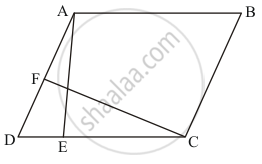
In the given figure, ABCD is a parallelogram. If AB = 12 cm, AE = 7.5 cm, CF = 15 cm, then AD =
Advertisements
उत्तर
Given: (1) ABCD is a parallelogram.
(2) AB = 12 cm
(3) AE = 7.5 cm
(4) CF = 15cm
To find: AD
Calculation: We know that,
Area of a parallelogram = base × height
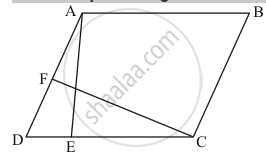
Area of a parallelogram ABCD = DC ×AE (with DC as base and AE as height) ……(1)
Area of a parallelogram ABCD = AD ×CF (with DC as base and AE as height) ……(2)
Since equation 1 and 2 both are Area of a parallelogram ABCD
`DC xx AE = AD xx CF`
`AD = (DC xx AE)/(CF)`
`AD = (AB xx AE)/(CF)` (AB = DC , opposite sides of parallelogram are eual )
`AD = (12 xx 7.5)/15`
AD = 6 cm
APPEARS IN
संबंधित प्रश्न
In Q. No 1, if AD = 6 cm, CF = 10 cm, and AE = 8cm, find AB.
Diagonals AC and BD of a quadrilateral ABCD intersect each other at P. Show that:
ar(ΔAPB) × ar(ΔCPD) = ar(ΔAPD) × ar (ΔBPC)
If P is any point in the interior of a parallelogram ABCD, then prove that area of the
triangle APB is less than half the area of parallelogram.
ABCD is a parallelogram whose diagonals AC and BD intersect at O. A line through O
intersects AB at P and DC at Q. Prove that ar (Δ POA) = ar (Δ QOC).
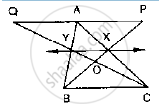
In the below fig. X and Y are the mid-points of AC and AB respectively, QP || BC and
CYQ and BXP are straight lines. Prove that ar (Δ ABP) = ar (ΔACQ).
ABCD is a rectangle with O as any point in its interior. If ar (ΔAOD) = 3 cm2 and ar (ΔABOC) = 6 cm2, then area of rectangle ABCD is
Find the area of a rectangle whose length = 15 cm breadth = 6.4 cm
Find the area of a rectangle whose length = 24 cm breadth =180 mm
By counting squares, estimate the area of the figure.
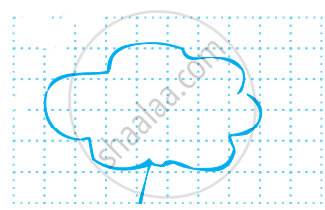
If each square on this page is equal to 1 square meter of land, how much land will each of her children get? ________ square m
