Advertisements
Advertisements
प्रश्न
In the given figure, find the area of ΔGEF.
Advertisements
उत्तर
Given: (1) ABCD is a rectangle.
(2) CD = 6 cm
(3) AD = 8cm
To find: Area of ΔGEF.
Calculation: We know that,
Area of Parallelogram = base × height
If a triangle and a parallelogram are on the same base and between the same parallels , the area of the triangle is equal to half of the parallelogram

Here we can see that Parallelogram ABCD and triangle GEF are between the same base and same parallels.
Hence,
Area of ΔGEF = `1/2` Area of Parallelogram ABCD
`= 1/2 xx AD xx CD `
`= 1/2 xx 8 xx6`
= 24 cm2
Hence we get the result as Area of ΔGEF = 24 cm2
APPEARS IN
संबंधित प्रश्न
In Q. No 1, if AD = 6 cm, CF = 10 cm, and AE = 8cm, find AB.
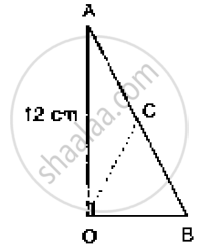
In the below fig. ∠AOB = 90°, AC = BC, OA = 12 cm and OC = 6.5 cm. Find the area of
ΔAOB.
Let ABC be a triangle of area 24 sq. units and PQR be the triangle formed by the mid-points of the sides of Δ ABC. Then the area of ΔPQR is
A, B, C, D are mid-points of sides of parallelogram PQRS. If ar (PQRS) = 36 cm2, then ar (ABCD) =
Find the area of a rectangle whose length = 15 cm breadth = 6.4 cm
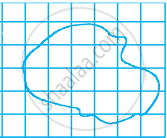
By counting squares, estimate the area of the figure.
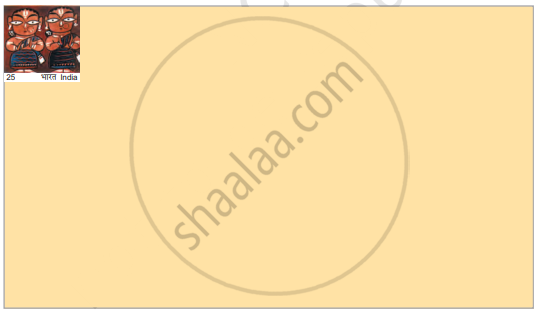
This stamp has an area of 4 square cm. Guess how many such stamps will cover this big rectangle.
Cheggu’s wife asked him to make a circle with the wire. She knew it had an area of 800 square meters.
- Why did Cheggu not choose a rectangle? Explain.
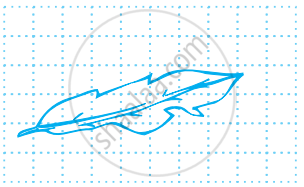
Find the area of the following figure by counting squares:
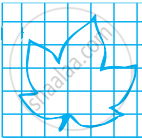
Find the area of the following figure by counting squares: