Advertisements
Advertisements
Question
In the given figure, find the area of ΔGEF.
Advertisements
Solution
Given: (1) ABCD is a rectangle.
(2) CD = 6 cm
(3) AD = 8cm
To find: Area of ΔGEF.
Calculation: We know that,
Area of Parallelogram = base × height
If a triangle and a parallelogram are on the same base and between the same parallels , the area of the triangle is equal to half of the parallelogram

Here we can see that Parallelogram ABCD and triangle GEF are between the same base and same parallels.
Hence,
Area of ΔGEF = `1/2` Area of Parallelogram ABCD
`= 1/2 xx AD xx CD `
`= 1/2 xx 8 xx6`
= 24 cm2
Hence we get the result as Area of ΔGEF = 24 cm2
APPEARS IN
RELATED QUESTIONS
If ABCD is a parallelogram, then prove that
𝑎𝑟 (Δ𝐴𝐵𝐷) = 𝑎𝑟 (Δ𝐵𝐶𝐷) = 𝑎𝑟 (Δ𝐴𝐵𝐶) = 𝑎𝑟 (Δ𝐴𝐶𝐷) = `1/2` 𝑎𝑟 (||𝑔𝑚 𝐴𝐵𝐶𝐷) .
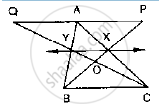
In the below fig. X and Y are the mid-points of AC and AB respectively, QP || BC and
CYQ and BXP are straight lines. Prove that ar (Δ ABP) = ar (ΔACQ).
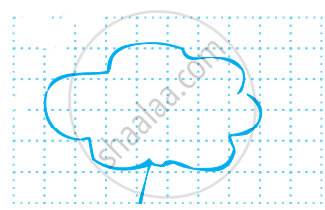
By counting squares, estimate the area of the figure.
Find the area and perimeter of the following parallelograms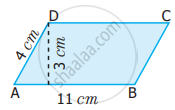
Which has the bigger area - one of your footprints or the page of this book?
Parth and Gini bought aam papad (dried mango slice) from a shop. Their pieces looked like these. Both could not make out whose piece was bigger.
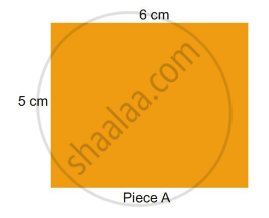

- Suggest some ways to find out whose piece is bigger. Discuss
Who had the bigger piece? How much bigger?
Is the area of your belt the same as the area of the postcard? Why or why not?
Look at the table. If you were to write the area of each of these which column would you choose? Make a (✓).
| Square cm |
Square meter |
Square km |
|
| Handkerchief | ✓ | ||
| Sari | |||
| Page of your book | |||
| School land | |||
| Total land of a city | |||
| Door of your classroom | |||
| Chair seat | |||
| Blackboard | |||
| Indian flag | |||
| Land over which a river flows |
Karunya bought three fields.

Find the area of all three fields.
- Field (A) ____________ square metre.
- Field (B) ____________ square metre.
- Field (C) ____________ square metre.
