Advertisements
Advertisements
Question
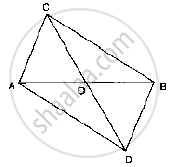
In the below Fig, ABC and ABD are two triangles on the base AB. If line segment CD is
bisected by AB at O, show that ar (Δ ABC) = ar (Δ ABD)
Advertisements
Solution
Given that CD is bisected at O by AB
To prove: ar (ΔABC) = ar (ΔABD)
Construction: Draw CP ⊥ AB and DQ ⊥ AB
Proof:-
`ar (ΔABC) = 1/2 xx AB xx CP` ........ (1)
`ar (ΔABC) = 1/2 xx AB xx DQ ` ........ (2)
In ∠CPO and ΔDQO
∠CPQ = ΔDQO [Each 90°]
Given that CO = DO
∠COP = ∠DOQ [vertically opposite angles are equal]
Than, ΔCPO ≅ DQO [By AAS condition]
∴ CP = DQ ........... (3) [CP.C.T]
Compare equation (1), (2) and (3)
Area ( ΔABC)a = area of ΔABD
APPEARS IN
RELATED QUESTIONS
If ABCD is a parallelogram, then prove that
𝑎𝑟 (Δ𝐴𝐵𝐷) = 𝑎𝑟 (Δ𝐵𝐶𝐷) = 𝑎𝑟 (Δ𝐴𝐵𝐶) = 𝑎𝑟 (Δ𝐴𝐶𝐷) = `1/2` 𝑎𝑟 (||𝑔𝑚 𝐴𝐵𝐶𝐷) .
If P is any point in the interior of a parallelogram ABCD, then prove that area of the
triangle APB is less than half the area of parallelogram.
ABC is a triangle in which D is the mid-point of BC. E and F are mid-points of DC and AErespectively. IF area of ΔABC is 16 cm2, find the area of ΔDEF.
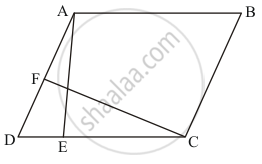
In the given figure, ABCD is a parallelogram. If AB = 12 cm, AE = 7.5 cm, CF = 15 cm, then AD =
ABCD is a rectangle with O as any point in its interior. If ar (ΔAOD) = 3 cm2 and ar (ΔABOC) = 6 cm2, then area of rectangle ABCD is
Find the area of a rectangle whose length and breadth are 25 m and 16 cm.
Each side of a square is 7 m. If its each side be increased by 3 m, what will be the increase in its area.
Each line gives a story. You have to choose the question which makes the best story problem. The first one is already marked.
- 352 children from a school went on a camping trip. Each tent had a group of 4 children.
a) How many children did each tent have? b) How many tents do they need? c) How many children in all are in the school?
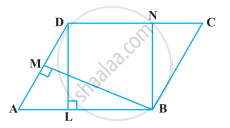
In the following figure, the area of parallelogram ABCD is ______.
Find the area of the following figure by counting squares: