Advertisements
Advertisements
Question
The figure obtained by joining the mid-points of the adjacent sides of a rectangle of sides 8 cm and 6 cm is ______.
Options
a rhombus of area 24 cm2
a rectangle of area 24 cm2
a square of area 26 cm2
a trapezium of area 14 cm2
Advertisements
Solution
The figure obtained by joining the mid-points of the adjacent sides of a rectangle of sides 8 cm and 6 cm is a rhombus of area 24 cm2.
Explanation:
Given: Rectangle with sides 8 cm and 6 cm
To find: Area of the figure which is formed by joining the midpoints of the adjacent sides of rectangle.
Calculation: Since we know that area of rhombus = `1/2 (d_1 xx d_2)`

For rhombus EFGH, EG is the one diagonal which is equal to DA
FH is the other diagonal which is equal to AB
Area of rhombus = `1/2 (d_1 xx d_2)`
Area of rhombus = `1/2 ( 8 xx 6)`
Area of rhombus = `1/2 (48)`
Area of rhombus = 24 cm2
RELATED QUESTIONS
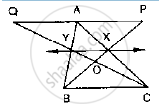
In the below fig. X and Y are the mid-points of AC and AB respectively, QP || BC and
CYQ and BXP are straight lines. Prove that ar (Δ ABP) = ar (ΔACQ).
Two parallelograms are on the same base and between the same parallels. The ratio of their areas is
Medians of ΔABC intersect at G. If ar (ΔABC) = 27 cm2, then ar (ΔBGC) =
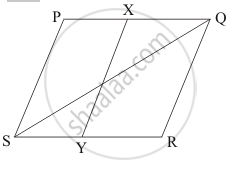
In the given figure, PQRS is a parallelogram. If X and Y are mid-points of PQ and SRrespectively and diagonal Q is joined. The ratio ar (||gm XQRY) : ar (ΔQSR) =
Find the area of a square, whose side is: 4.1 cm.
By counting squares, estimate the area of the figure.
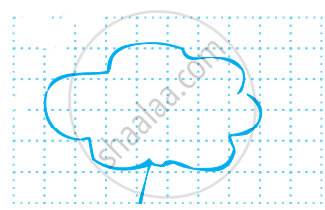
If each square on this page is equal to 1 square meter of land, how much land will each of her children get? ________ square m
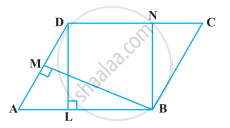
In the following figure, the area of parallelogram ABCD is ______.
Find the area of the following figure by counting squares:

Find the area of the following figure by counting squares: