Advertisements
Advertisements
Question
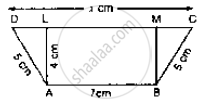
In the below fig. ABCD is a trapezium in which AB = 7 cm, AD = BC = 5 cm, DC = x cm,
and distance between AB and DC is 4cm. Find the value of x and area of trapezium ABCD.
Advertisements
Solution
Draw AL ⊥ DC, BM ⊥ DC Then ,
AL = BM = 4cm and LM = 7 cm
In ΔADL, we have
AD2 = AL2 + DL2 ⇒ 25 = 16 + DL2 ⇒ DL= 3 cm
`Similarly MC = sqrt(BC^2-BM^2)=sqrt(25-16)=3cm`
∴ x = CD = CM + ML + CD = 3 + 7 + 3 = 13cm
`ar (trap . ABCD ) = 1/2 ( AB + CD) × AL 1/2 (7 + 13) xx 4cm^2`
= 4cm2
APPEARS IN
RELATED QUESTIONS
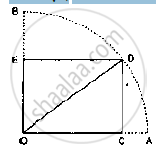
In the below fig. OCDE is a rectangle inscribed in a quadrant of a circle of radius 10 cm. If
OE = 2√5, find the area of the rectangle.
If P is any point in the interior of a parallelogram ABCD, then prove that area of the
triangle APB is less than half the area of parallelogram.
ABCD is a parallelogram. E is a point on BA such that BE = 2 EA and F is a point on DC
such that DF = 2 FC. Prove that AE CF is a parallelogram whose area is one third of the
area of parallelogram ABCD.
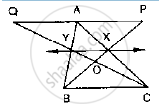
In the below fig. X and Y are the mid-points of AC and AB respectively, QP || BC and
CYQ and BXP are straight lines. Prove that ar (Δ ABP) = ar (ΔACQ).
In square ABCD, P and Q are mid-point of AB and CD respectively. If AB = 8cm and PQand BD intersect at O, then find area of ΔOPB.
Let ABC be a triangle of area 24 sq. units and PQR be the triangle formed by the mid-points of the sides of Δ ABC. Then the area of ΔPQR is
In a ΔABC if D and E are mid-points of BC and AD respectively such that ar (ΔAEC) = 4cm2, then ar (ΔBEC) =
The perimeter of a triangle ABC is 37 cm and the ratio between the lengths of its altitudes be 6: 5: 4. Find the lengths of its sides.
Let the sides be x cm, y cm, and (37 - x - y) cm. Also, let the lengths of altitudes be 6a cm, 5a cm, and 4a cm.
Find the area and perimeter of the following parallelograms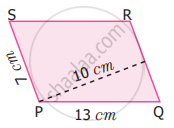
Is the area of the blue shape more than the area of the yellow shape? Why?