Advertisements
Advertisements
Question
Find the area and perimeter of the following parallelograms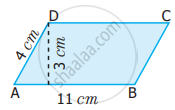
Advertisements
Solution
Given: base b = 11 cm
height h = 3 cm
Area of the parallelogram = b × h sq.units
= 11 × 3 cm2
= 33 cm2
Also perimeter of a parallelogram = Sum of 4 sides
= 11 cm + 4 cm + 11 cm + 4 cm
= 30 cm
Area = 33 cm2, Perimeter = 30 cm.
APPEARS IN
RELATED QUESTIONS
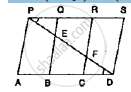
In below fig., PSDA is a parallelogram in which PQ = QR = RS and AP || BQ || CR. Prove
that ar (Δ PQE) = ar (ΔCFD).
In the given figure, find the area of ΔGEF.
A triangle and a parallelogram are on the same base and between the same parallels. The ratio of the areas of triangle and parallelogram is
Which has the bigger area - one of your footprints or the page of this book?
Parth and Gini bought aam papad (dried mango slice) from a shop. Their pieces looked like these. Both could not make out whose piece was bigger.
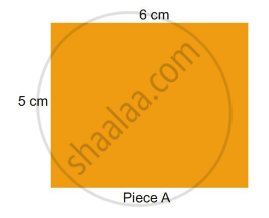

- Suggest some ways to find out whose piece is bigger. Discuss
Cheggu’s wife asked him to make a circle with the wire. She knew it had an area of 800 square meters.
- Why did Cheggu not choose a rectangle? Explain.
Measure the length of the floor of your classroom in meters. Also measure the width.
- If you want to move around easily then how many children do you think should be there in one square meter?
The region given in the following figure is measured by taking  as a unit. What is the area of the region?
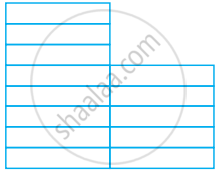
Find the area of the following figure by counting squares:
If a figure contains only 8 fully-filled squares and no partial squares, what is its area?
