Advertisements
Advertisements
Question
In square ABCD, P and Q are mid-point of AB and CD respectively. If AB = 8cm and PQand BD intersect at O, then find area of ΔOPB.
Advertisements
Solution
Given: Here from the given question we get
(1) ABCD is a square,
(2) P is the midpoint of AB
(3) Q is the midpoint of CD
(4) PQ and BD intersect at O.
(5) AB = 8cm
To find : Area of ΔOPB
Calculation: Since P is the midpoint of AB,
`BP = 1/2 (AB) `
= 1/2 (8)`
= 4 cm
BP = 4cm ……(1)
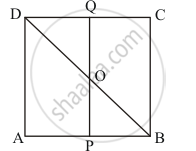
Area of triangle = `1/2 `× base × height
Area of ΔOPB = `1/2` × BP × PO (from 1)
` = 1/2 × 4 × (PO = 1/2 AD , APQD ` is a rectangle)
`= 1/2 × 16 `
Area of ΔOPB = 8 cm2
Hence we get the Area of ΔOBP = 8 cm2
APPEARS IN
RELATED QUESTIONS
In Q. No 1, if AD = 6 cm, CF = 10 cm, and AE = 8cm, find AB.
Two parallelograms are on the same base and between the same parallels. The ratio of their areas is
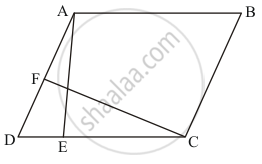
In the given figure, ABCD is a parallelogram. If AB = 12 cm, AE = 7.5 cm, CF = 15 cm, then AD =
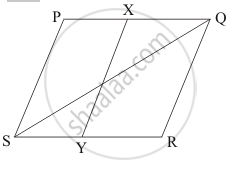
In the given figure, PQRS is a parallelogram. If X and Y are mid-points of PQ and SRrespectively and diagonal Q is joined. The ratio ar (||gm XQRY) : ar (ΔQSR) =
ABCD is a trapezium with parallel sides AB =a and DC = b. If E and F are mid-points of non-parallel sides AD and BC respectively, then the ratio of areas of quadrilaterals ABFEand EFCD is
ABCD is a rectangle with O as any point in its interior. If ar (ΔAOD) = 3 cm2 and ar (ΔABOC) = 6 cm2, then area of rectangle ABCD is
Altogether how many squares can be arranged on it?
In the same way, find the area of piece B.
The King was very happy with carpenters Cheggu and Anar. They had made a very big and beautiful bed for him. So as gifts the king wanted to give some land to Cheggu, and some gold to Anar. Cheggu was happy. He took 100 meters of wire and tried to make different rectangles.
He made a 10 m × 40 m rectangle. Its area was 400 square meters. So he next made a 30 m × 20 m rectangle.
- What other rectangles can he make with 100 meters of wire? Discuss which of these rectangles will have the biggest area.
Which unit is used to express area?
