Advertisements
Advertisements
Question
Find the area and perimeter of the following parallelograms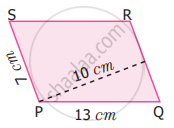
Advertisements
Solution
Given: base b = 7 cm
height h = 10 cm
Area of the parallelogram = b × h sq.units
= 7 × 10 cm2
= 70 cm2
Perimeter = Sum of four sides
= 13 cm + 7 cm + 13 cm + 7 cm
= 40 cm
Area = 70 cm2, Perimeter = 40 cm
APPEARS IN
RELATED QUESTIONS
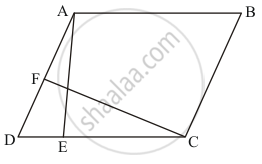
In Q. No 1, if AD = 6 cm, CF = 10 cm, and AE = 8cm, find AB.
If ABCD is a parallelogram, then prove that
𝑎𝑟 (Δ𝐴𝐵𝐷) = 𝑎𝑟 (Δ𝐵𝐶𝐷) = 𝑎𝑟 (Δ𝐴𝐵𝐶) = 𝑎𝑟 (Δ𝐴𝐶𝐷) = `1/2` 𝑎𝑟 (||𝑔𝑚 𝐴𝐵𝐶𝐷) .
ABCD is a parallelogram whose diagonals intersect at O. If P is any point on BO, prove
that: (1) ar (ΔADO) = ar (ΔCDO) (2) ar (ΔABP) = ar (ΔCBP)
If AD is median of ΔABC and P is a point on AC such that
ar (ΔADP) : ar (ΔABD) = 2 : 3, then ar (Δ PDC) : ar (Δ ABC)
In a ΔABC if D and E are mid-points of BC and AD respectively such that ar (ΔAEC) = 4cm2, then ar (ΔBEC) =
In the given figure, ABCD is a parallelogram. If AB = 12 cm, AE = 7.5 cm, CF = 15 cm, then AD =
Is the area of the blue shape more than the area of the yellow shape? Why?


Each line gives a story. You have to choose the question which makes the best story problem. The first one is already marked.
- The cost of one book is Rs 47. Sonu buys 23 books.
a) How much money does she have? b) How much money does she pay for the books? c) What is the cost of 47 books?
The amount of region enclosed by a plane closed figure is called its ______.
Find the area of the following figure by counting squares:

