Advertisements
Advertisements
Question
ABCD is a parallelogram whose diagonals intersect at O. If P is any point on BO, prove
that: (1) ar (ΔADO) = ar (ΔCDO) (2) ar (ΔABP) = ar (ΔCBP)
Advertisements
Solution
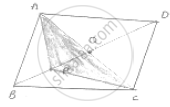
Given that ABCD is a parallelogram
To prove: (1) ar (ΔADO) = ar (ΔCDO)
(2) ar ( ΔABP) = ar (ΔCBP)
Then area (ΔADO) = area (ΔCDO)
Then; area (ΔBAO) area (ΔBCO) ......(1)
In a ΔPAC, Since PO is a median
Then, area (ΔPAO) = area (ΔPCO) ......(2)
⇒ Area (ΔABP) = Area of ΔCBP
APPEARS IN
RELATED QUESTIONS
Diagonals AC and BD of a quadrilateral ABCD intersect each other at P. Show that:
ar(ΔAPB) × ar(ΔCPD) = ar(ΔAPD) × ar (ΔBPC)
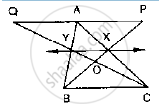
In the below fig. X and Y are the mid-points of AC and AB respectively, QP || BC and
CYQ and BXP are straight lines. Prove that ar (Δ ABP) = ar (ΔACQ).
The length and breadth of a rectangular piece of land are in the ratio 5 : 3. If the total cost of fencing it at the rate of ₹24 per meter is ₹9600, find its :
(i) length and breadth
(ii) area
(iii) cost of levelling at the rate of ₹60 per m2.
Each side of a square is 7 m. If its each side be increased by 3 m, what will be the increase in its area.
Find the area and perimeter of the following parallelograms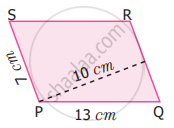
Look at a 10 rupee note. Is its area more than hundred square cm?
Is the area of the blue shape more than the area of the yellow shape? Why?


Parth and Gini bought aam papad (dried mango slice) from a shop. Their pieces looked like these. Both could not make out whose piece was bigger.
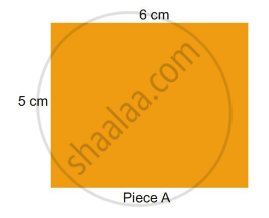

- Suggest some ways to find out whose piece is bigger. Discuss
In the same way, find the area of piece B.
Find all the possible dimensions (in natural numbers) of a rectangle with a perimeter 36 cm and find their areas.
