Advertisements
Advertisements
Question
D is the mid-point of side BC of ΔABC and E is the mid-point of BD. if O is the mid-point
of AE, prove that ar (ΔBOE) = `1/8` ar (Δ ABC).
Advertisements
Solution
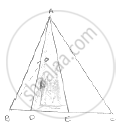
Given that
D is the midpoint of side BC of ΔABC .
E is the midpoint of BD and
O is the midpoint of AE
Since AD and AE are the medians of ΔABC and ABD respectively
∴ ar (Δ ABC) = `1/2` AR (ΔABC) ........... (1)
ar (ΔABE) `1/2` ar (ΔABD) ........... (2)
OB is a median of (ΔABE)
∴ ar (ΔBOE) = `1/2` ar (ΔABE)
From 1, (2) and (3) we have
ar (BOE) =`1/8` ar (ΔABC)
APPEARS IN
RELATED QUESTIONS
Two parallelograms are on the same base and between the same parallels. The ratio of their areas is
A triangle and a parallelogram are on the same base and between the same parallels. The ratio of the areas of triangle and parallelogram is
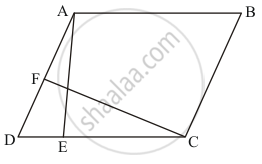
In the given figure, ABCD is a parallelogram. If AB = 12 cm, AE = 7.5 cm, CF = 15 cm, then AD =
ABCD is a trapezium with parallel sides AB =a and DC = b. If E and F are mid-points of non-parallel sides AD and BC respectively, then the ratio of areas of quadrilaterals ABFEand EFCD is
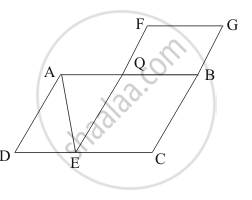
In the given figure, ABCD and FECG are parallelograms equal in area. If ar (ΔAQE) = 12 cm2, then ar (||gm FGBQ) =
The sides of a rectangular park are in the ratio 4 : 3. If its area is 1728 m2, find
(i) its perimeter
(ii) cost of fencing it at the rate of ₹40 per meter.
Find the area of a rectangle whose length = 24 cm breadth =180 mm
What will happen to the area of a rectangle, if its length and breadth both are trebled?
Look at a 10 rupee note. Is its area more than hundred square cm?
So the area of piece A = ________ square cm
