Advertisements
Advertisements
Question
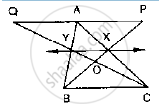
In the below fig. X and Y are the mid-points of AC and AB respectively, QP || BC and
CYQ and BXP are straight lines. Prove that ar (Δ ABP) = ar (ΔACQ).
Advertisements
Solution
Since x and y are the midpoint AC and AB respectively
∴ XY ll BC
Clearly, triangles BYC and BXC are on the same base BC and between the same parallels
XY and BC
∴ area (ΔBYC) = area (BXC)
⇒ area (ΔBYC) = ar (ΔBOC) = ar (ΔBXC) - ar (BOC)
⇒ ar (ΔBOY) = ar (ΔCOX)
⇒ ar ( BOY) + ar (XOY) = ar (ΔCOX) + ar (ΔXOY)
⇒ ar (ΔBXY = ar (ΔCXY)
We observe that the quadrilateral XYAP and XYAQ are on the same base XY and between
the same parallel XY and PQ.
∴ area (quad XYAP ) ar (quad XYPA) ....(2)
Adding (1) and (2), we get
ar (ΔBXY) + ar (quad XYAP) = ar (CXY) + ar (quad XYQA)
⇒ ar (ΔABP) = ar (ΔACQ)
APPEARS IN
RELATED QUESTIONS
A point D is taken on the side BC of a ΔABC such that BD = 2DC. Prove that ar(Δ ABD) =
2ar (ΔADC).
The median of a triangle divides it into two ______.
In a ΔABC, D, E, F are the mid-points of sides BC, CA and AB respectively. If ar (ΔABC) = 16cm2, then ar (trapezium FBCE) =
Find the area of a square, whose side is: 4.5 cm.
By counting squares, estimate the area of the figure.
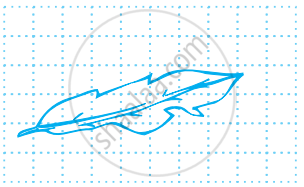
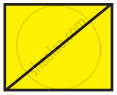
Is the area of the blue shape more than the area of the yellow shape? Why?

What is the area of the rectangle? ________ square cm
The region given in the following figure is measured by taking  as a unit. What is the area of the region?

Find the area of the following figure by counting squares:

Find the area of the following figure by counting squares: