Advertisements
Advertisements
प्रश्न
Find the area and perimeter of the following parallelograms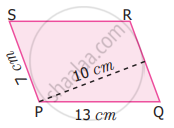
Advertisements
उत्तर
Given: base b = 7 cm
height h = 10 cm
Area of the parallelogram = b × h sq.units
= 7 × 10 cm2
= 70 cm2
Perimeter = Sum of four sides
= 13 cm + 7 cm + 13 cm + 7 cm
= 40 cm
Area = 70 cm2, Perimeter = 40 cm
APPEARS IN
संबंधित प्रश्न
ABCD is a parallelogram whose diagonals AC and BD intersect at O. A line through O
intersects AB at P and DC at Q. Prove that ar (Δ POA) = ar (Δ QOC).
In the given figure, ABCD is a rectangle in which CD = 6 cm, AD = 8 cm. Find the area of parallelogram CDEF.
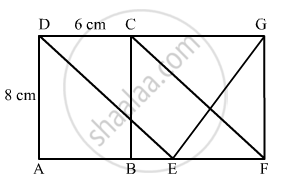
In the given figure, find the area of ΔGEF.
P is any point on base BC of ΔABC and D is the mid-point of BC. DE is drawn parallel toPA to meet AC at E. If ar (ΔABC) = 12 cm2, then find area of ΔEPC.
The figure obtained by joining the mid-points of the adjacent sides of a rectangle of sides 8 cm and 6 cm is ______.
If AD is median of ΔABC and P is a point on AC such that
ar (ΔADP) : ar (ΔABD) = 2 : 3, then ar (Δ PDC) : ar (Δ ABC)
Each side of a square is 7 m. If its each side be increased by 3 m, what will be the increase in its area.
The region given in the following figure is measured by taking  as a unit. What is the area of the region?
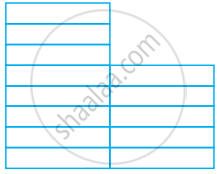
Find all the possible dimensions (in natural numbers) of a rectangle with a perimeter 36 cm and find their areas.
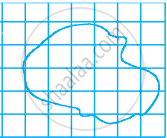
Find the area of the following figure by counting squares: