Advertisements
Advertisements
प्रश्न
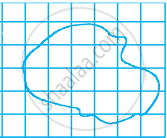
Find the area of the following figure by counting squares:
Advertisements
उत्तर
From the given figure, we observe
| Covered Area | Number | Area estimate (square units) |
| Fully filled squares | 8 | 8 |
| Half filled squares | – | – |
| More than half-filled squares | 10 | 10 |
| Less than half-filled squares | 9 | 0 |
Therefore total area = 8 + 10 = 18 square units.
संबंधित प्रश्न
Two parallelograms are on the same base and between the same parallels. The ratio of their areas is
In a ΔABC if D and E are mid-points of BC and AD respectively such that ar (ΔAEC) = 4cm2, then ar (ΔBEC) =
ABCD is a trapezium with parallel sides AB =a and DC = b. If E and F are mid-points of non-parallel sides AD and BC respectively, then the ratio of areas of quadrilaterals ABFEand EFCD is
A floor is 40 m long and 15 m broad. It is covered with tiles, each measuring 60 cm by 50 cm. Find the number of tiles required to cover the floor.
Find the area of a rectangle whose length = 3.6 m breadth = 90 cm
The side of a square field is 16 m. What will be increase in its area, if each of its sides is increased by 4 m?
The table given below contains some measures of the rectangle. Find the unknown values.
| Length | Breadth | Perimeter | Area |
| ? | 15 cm | 60 cm | ? |
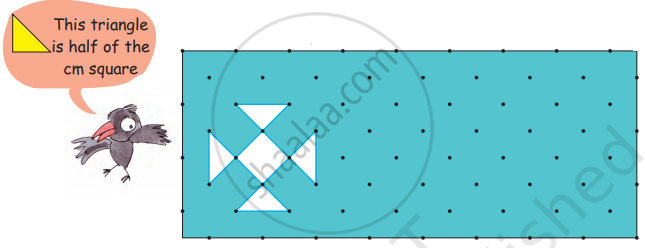
How many tiles like the triangle given here will fit in the white design?
Area of design = ________ square cm
The region given in the following figure is measured by taking  as a unit. What is the area of the region?
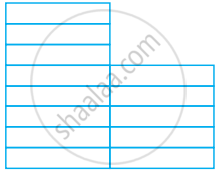
Find the area of the following figure by counting squares: