Advertisements
Advertisements
प्रश्न
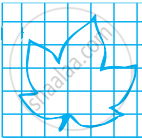
Find the area of the following figure by counting squares:
Advertisements
उत्तर
From the given figure, we observe
| Covered Area | Number | Area estimate (square units) |
| Fully filled squares | 5 | 5 |
| Half filled squares | – | – |
| More than half-filled squares | 9 | 9 |
| Less than half-filled squares | 12 | 0 |
Therefore total area = 5 + 9 = 14 square units.
संबंधित प्रश्न
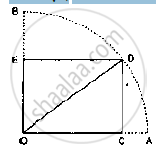
In the below fig. OCDE is a rectangle inscribed in a quadrant of a circle of radius 10 cm. If
OE = 2√5, find the area of the rectangle.
If ABC and BDE are two equilateral triangles such that D is the mid-point of BC, then find ar (ΔABC) : ar (ΔBDE).
Medians of ΔABC intersect at G. If ar (ΔABC) = 27 cm2, then ar (ΔBGC) =
Find the area of a square, whose side is: 4.1 cm.
Each side of a square is 7 m. If its each side be increased by 3 m, what will be the increase in its area.
The side of a square field is 16 m. What will be increase in its area, if each of its sides is increased by 4 m?
So the area of piece A = ________ square cm
Cheggu’s wife asked him to make a circle with the wire. She knew it had an area of 800 square meters.
- Why did Cheggu not choose a rectangle? Explain.
Karunya bought three fields.

Find the area of all three fields.
- Field (A) ____________ square metre.
- Field (B) ____________ square metre.
- Field (C) ____________ square metre.
The region given in the following figure is measured by taking  as a unit. What is the area of the region?