Advertisements
Advertisements
प्रश्न
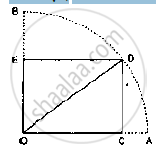
In the below fig. OCDE is a rectangle inscribed in a quadrant of a circle of radius 10 cm. If
OE = 2√5, find the area of the rectangle.
Advertisements
उत्तर
Given OD = 10cm and OE `root (2)(5)cm`
By using Pythagoras theorem
∴ `OD^2 = OE^2 + DE^2`
⇒ `DE = sqrt( OD^2 - OF^2)` = ` sqrt (( 10 )^2 - (root2(5)))^2` = `root 4 (5)cm`
∴ `ar (rect DCDE) = OExx DE = root2( 5) xx root 4 (5 )cm^2`
= `40 cm^ 2 [ ∴ sqrt5 xx sqrt 5 = 5]`
APPEARS IN
संबंधित प्रश्न
If ABC and BDE are two equilateral triangles such that D is the mid-point of BC, then find ar (ΔABC) : ar (ΔBDE).
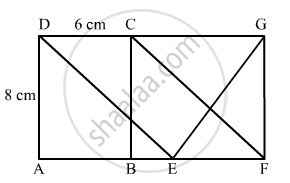
In the given figure, ABCD is a rectangle in which CD = 6 cm, AD = 8 cm. Find the area of parallelogram CDEF.
Let ABC be a triangle of area 24 sq. units and PQR be the triangle formed by the mid-points of the sides of Δ ABC. Then the area of ΔPQR is
In a ΔABC, D, E, F are the mid-points of sides BC, CA and AB respectively. If ar (ΔABC) = 16cm2, then ar (trapezium FBCE) =
The length and breadth of a rectangular piece of land are in the ratio 5 : 3. If the total cost of fencing it at the rate of ₹24 per meter is ₹9600, find its :
(i) length and breadth
(ii) area
(iii) cost of levelling at the rate of ₹60 per m2.
Find the area of a square, whose side is: 4.1 cm.
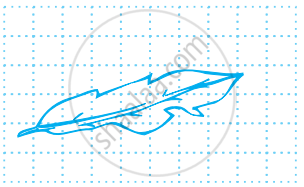
By counting squares, estimate the area of the figure.
An engineer who plans to build a compound wall on all sides of a house must find the area of the compound.
Is the area of both your footprints the same?
Which unit is used to express area?
