Advertisements
Advertisements
प्रश्न
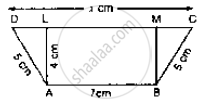
In the below fig. ABCD is a trapezium in which AB = 7 cm, AD = BC = 5 cm, DC = x cm,
and distance between AB and DC is 4cm. Find the value of x and area of trapezium ABCD.
Advertisements
उत्तर
Draw AL ⊥ DC, BM ⊥ DC Then ,
AL = BM = 4cm and LM = 7 cm
In ΔADL, we have
AD2 = AL2 + DL2 ⇒ 25 = 16 + DL2 ⇒ DL= 3 cm
`Similarly MC = sqrt(BC^2-BM^2)=sqrt(25-16)=3cm`
∴ x = CD = CM + ML + CD = 3 + 7 + 3 = 13cm
`ar (trap . ABCD ) = 1/2 ( AB + CD) × AL 1/2 (7 + 13) xx 4cm^2`
= 4cm2
APPEARS IN
संबंधित प्रश्न
In Q. No 1, if AD = 6 cm, CF = 10 cm, and AE = 8cm, find AB.
Let ABCD be a parallelogram of area 124 cm2. If E and F are the mid-points of sides AB and
CD respectively, then find the area of parallelogram AEFD.
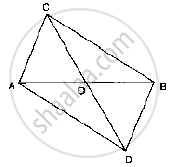
In the below Fig, ABC and ABD are two triangles on the base AB. If line segment CD is
bisected by AB at O, show that ar (Δ ABC) = ar (Δ ABD)
The area of the figure formed by joining the mid-points of the adjacent sides of a rhombus with diagonals 16 cm and 12 cm is
The sides of a rectangular park are in the ratio 4 : 3. If its area is 1728 m2, find
(i) its perimeter
(ii) cost of fencing it at the rate of ₹40 per meter.
Find the area of a square, whose side is: 7.2 cm.
Find the area and perimeter of the following parallelograms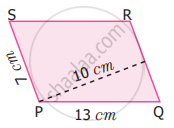
Parth and Gini bought aam papad (dried mango slice) from a shop. Their pieces looked like these. Both could not make out whose piece was bigger.
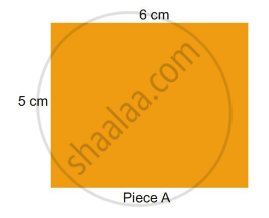

- Suggest some ways to find out whose piece is bigger. Discuss
Cheggu’s wife asked him to make a circle with the wire. She knew it had an area of 800 square meters.
- Why did Cheggu not choose a rectangle? Explain.
The amount of region enclosed by a plane closed figure is called its ______.
