Advertisements
Advertisements
प्रश्न
Karunya bought three fields.

Find the area of all three fields.
- Field (A) ____________ square metre.
- Field (B) ____________ square metre.
- Field (C) ____________ square metre.
Advertisements
उत्तर
Area of field A:
Area of rectangle
= Length × Breadth
= 28 × 27
= 756 square m
28
× 27
196
+ 560
756
Area of field B:
Area of rectangle
= Length × Breadth
= 36 × 12
= 432 square m
36
× 12
72
+ 360
432
Area of field C:
Area of rectangle
= Length × Breadth
= 27 × 19
= 513 square m
27
× 19
243
+ 270
513
संबंधित प्रश्न
In Q. No 1, if AD = 6 cm, CF = 10 cm, and AE = 8cm, find AB.
Diagonals AC and BD of a quadrilateral ABCD intersect each other at P. Show that:
ar(ΔAPB) × ar(ΔCPD) = ar(ΔAPD) × ar (ΔBPC)
ABCD is a parallelogram whose diagonals intersect at O. If P is any point on BO, prove
that: (1) ar (ΔADO) = ar (ΔCDO) (2) ar (ΔABP) = ar (ΔCBP)
ABCD is a parallelogram. E is a point on BA such that BE = 2 EA and F is a point on DC
such that DF = 2 FC. Prove that AE CF is a parallelogram whose area is one third of the
area of parallelogram ABCD.
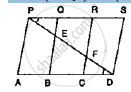
In below fig., PSDA is a parallelogram in which PQ = QR = RS and AP || BQ || CR. Prove
that ar (Δ PQE) = ar (ΔCFD).
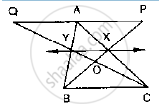
In the below fig. X and Y are the mid-points of AC and AB respectively, QP || BC and
CYQ and BXP are straight lines. Prove that ar (Δ ABP) = ar (ΔACQ).
If ABC and BDE are two equilateral triangles such that D is the mid-point of BC, then find ar (ΔABC) : ar (ΔBDE).
ABCD is a parallelogram. P is the mid-point of AB. BD and CP intersect at Q such that CQ: QP = 3.1. If ar (ΔPBQ) = 10cm2, find the area of parallelogram ABCD.
Let ABC be a triangle of area 24 sq. units and PQR be the triangle formed by the mid-points of the sides of Δ ABC. Then the area of ΔPQR is
ABCD is a parallelogram. P is any point on CD. If ar (ΔDPA) = 15 cm2 and ar (ΔAPC) = 20 cm2, then ar (ΔAPB) =
The area of the figure formed by joining the mid-points of the adjacent sides of a rhombus with diagonals 16 cm and 12 cm is
A, B, C, D are mid-points of sides of parallelogram PQRS. If ar (PQRS) = 36 cm2, then ar (ABCD) =
The figure obtained by joining the mid-points of the adjacent sides of a rectangle of sides 8 cm and 6 cm is ______.
Find the area of a rectangle whose length and breadth are 25 m and 16 cm.
Find the area of a rectangle whose length = 8.5 m breadth = 5 m.
Find the area of a square, whose side is: 7.2 cm.
Find the area of a square, whose side is: 4.5 cm.
Each side of a square is 7 m. If its each side be increased by 3 m, what will be the increase in its area.
Which has the bigger area - one of your footprints or the page of this book?
In the same way, find the area of piece B.
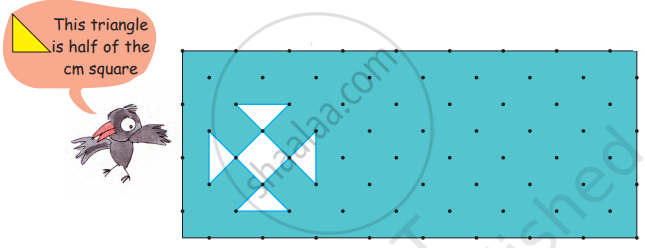
How many tiles like the triangle given here will fit in the white design?
Area of design = ________ square cm
Each line gives a story. You have to choose the question which makes the best story problem. The first one is already marked.
- A shopkeeper has 50 boxes. There are 48 fruits in one box.
Tick the one question which matches with the given problem.
Explain why (a) and (c) are not good choices.a) How much will the shopkeeper pay in all? b) How many fruits are there in all? ✓ c) How many more boxes will he need?
Each line gives a story. You have to choose the question which makes the best story problem. The first one is already marked.
- A shopkeeper has 204 eggs. He puts them in egg trays. Each tray has 12 eggs.
a) How many more eggs will he need? b) How many fresh eggs does he sell? c) How many egg trays does he need?
Measure the length of the floor of your classroom in meters. Also measure the width.
- If you want to move around easily then how many children do you think should be there in one square meter?
An engineer who plans to build a compound wall on all sides of a house must find the area of the compound.
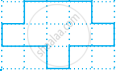
Find the area of the following figure by counting squares:
When using a square centimeter sheet for measurement, the area of one entire square equals:
