Advertisements
Advertisements
प्रश्न
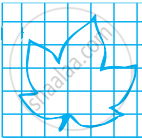
Find the area of the following figure by counting squares:

Advertisements
उत्तर
Number of complete enclosed squares = 5
Area = 5 × 1 = 5 square units
संबंधित प्रश्न
If AD is a median of a triangle ABC, then prove that triangles ADB and ADC are equal in
area. If G is the mid-point of median AD, prove that ar (Δ BGC) = 2 ar (Δ AGC).
In square ABCD, P and Q are mid-point of AB and CD respectively. If AB = 8cm and PQand BD intersect at O, then find area of ΔOPB.
A, B, C, D are mid-points of sides of parallelogram PQRS. If ar (PQRS) = 36 cm2, then ar (ABCD) =
ABCD is a trapezium in which AB || DC. If ar (ΔABD) = 24 cm2 and AB = 8 cm, then height of ΔABC is
Each side of a square is 7 m. If its each side be increased by 3 m, what will be the increase in its area.
The side of a square field is 16 m. What will be increase in its area, if each of its sides is doubled?
Find the area and perimeter of the following parallelograms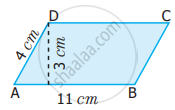
Area of a rectangle with length 5 cm and breadth 3 cm is ______.
An engineer who plans to build a compound wall on all sides of a house must find the area of the compound.
Find the area of the following figure by counting squares: