Advertisements
Advertisements
प्रश्न
An engineer who plans to build a compound wall on all sides of a house must find the area of the compound.
विकल्प
True
False
Advertisements
उत्तर
This statement is False.
Explanation:
To build a compound wall on all sides of a house, the engineer must find the perimeter of the compound.
APPEARS IN
संबंधित प्रश्न
ABCD is a parallelogram whose diagonals intersect at O. If P is any point on BO, prove
that: (1) ar (ΔADO) = ar (ΔCDO) (2) ar (ΔABP) = ar (ΔCBP)
ABCD is a parallelogram in which BC is produced to E such that CE = BC. AE intersects
CD at F.
(i) Prove that ar (ΔADF) = ar (ΔECF)
(ii) If the area of ΔDFB = 3 cm2, find the area of ||gm ABCD.
If ABC and BDE are two equilateral triangles such that D is the mid-point of BC, then find ar (ΔABC) : ar (ΔBDE).
In the given figure, find the area of ΔGEF.
In a ΔABC if D and E are mid-points of BC and AD respectively such that ar (ΔAEC) = 4cm2, then ar (ΔBEC) =
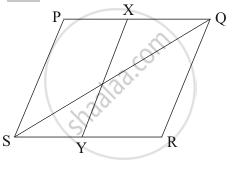
In the given figure, PQRS is a parallelogram. If X and Y are mid-points of PQ and SRrespectively and diagonal Q is joined. The ratio ar (||gm XQRY) : ar (ΔQSR) =
The sides of a rectangular park are in the ratio 4 : 3. If its area is 1728 m2, find
(i) its perimeter
(ii) cost of fencing it at the rate of ₹40 per meter.
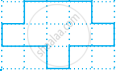
Find the area of the following figure by counting squares:
Which statement correctly describes how area is determined?
If a figure contains only 8 fully-filled squares and no partial squares, what is its area?
