Advertisements
Advertisements
प्रश्न
If ABC and BDE are two equilateral triangles such that D is the mid-point of BC, then find ar (ΔABC) : ar (ΔBDE).
Advertisements
उत्तर
Given: (1) ΔABC is equilateral triangle.
(2) ΔBDE is equilateral triangle.
(3) D is the midpoint of BC.
To find: ar (Δ ABC ) : ar (ΔBDE)
PROOF : Let us draw the figure as per the instruction given in the question.
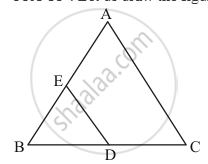
We know that area of equilateral triangle = `sqrt(3)/4 xx a^2`, where a is the side of the triangle.
Let us assume that length of BC is a cm.
This means that length of BD is `a/2` cm, Since D is the midpoint of BC.
∴ area of equilateral Δ ABC =`sqrt(3)/4 xx a^2` ------(1)
area of equilateral ΔBDE = `sqrt(3)/4 xx (a/2)^2` ------(2)
Now, ar(ΔABC) : ar(ΔBDE) =` sqrt(3)/4 xx a^2 : sqrt(3)/4 xx (a/2)^2` (from 1 and 2)
= 4 : 1
Hence we get the result ar(ΔABC) : ar(ΔBDE) = 4 : 1
APPEARS IN
संबंधित प्रश्न
In Q. No 1, if AD = 6 cm, CF = 10 cm, and AE = 8cm, find AB.
The diagonal of a rectangular board is 1 m and its length is 96 cm. Find the area of the board.
The length and breadth of a rectangular piece of land are in the ratio 5 : 3. If the total cost of fencing it at the rate of ₹24 per meter is ₹9600, find its :
(i) length and breadth
(ii) area
(iii) cost of levelling at the rate of ₹60 per m2.
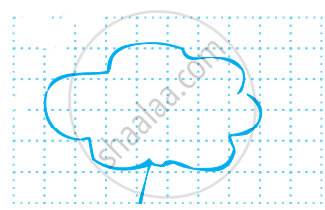
By counting squares, estimate the area of the figure.
The table given below contains some measures of the rectangle. Find the unknown values.
| Length | Breadth | Perimeter | Area |
| 13 cm | ? | 54 cm | ? |
Look at a 10 rupee note. Is its area more than hundred square cm?
What is the area of the rectangle? ________ square cm
Is the area of your belt the same as the area of the postcard? Why or why not?
The amount of region enclosed by a plane closed figure is called its ______.
A magazine charges Rs 300 per 10 sq cm area for advertising. A company decided to order a half page advertisment. If each page of the magazine is 15 cm × 24 cm, what amount will the company has to pay for it?
