Advertisements
Advertisements
प्रश्न
If ABC and BDE are two equilateral triangles such that D is the mid-point of BC, then find ar (ΔABC) : ar (ΔBDE).
Advertisements
उत्तर
Given: (1) ΔABC is equilateral triangle.
(2) ΔBDE is equilateral triangle.
(3) D is the midpoint of BC.
To find: ar (Δ ABC ) : ar (ΔBDE)
PROOF : Let us draw the figure as per the instruction given in the question.
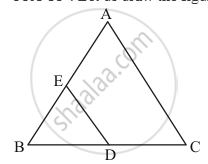
We know that area of equilateral triangle = `sqrt(3)/4 xx a^2`, where a is the side of the triangle.
Let us assume that length of BC is a cm.
This means that length of BD is `a/2` cm, Since D is the midpoint of BC.
∴ area of equilateral Δ ABC =`sqrt(3)/4 xx a^2` ------(1)
area of equilateral ΔBDE = `sqrt(3)/4 xx (a/2)^2` ------(2)
Now, ar(ΔABC) : ar(ΔBDE) =` sqrt(3)/4 xx a^2 : sqrt(3)/4 xx (a/2)^2` (from 1 and 2)
= 4 : 1
Hence we get the result ar(ΔABC) : ar(ΔBDE) = 4 : 1
APPEARS IN
संबंधित प्रश्न
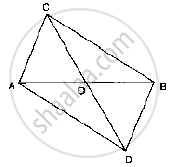
In the below Fig, ABC and ABD are two triangles on the base AB. If line segment CD is
bisected by AB at O, show that ar (Δ ABC) = ar (Δ ABD)
ABCD is a parallelogram whose diagonals intersect at O. If P is any point on BO, prove
that: (1) ar (ΔADO) = ar (ΔCDO) (2) ar (ΔABP) = ar (ΔCBP)
Find the area of a rectangle whose length = 24 cm breadth =180 mm
The side of a square field is 16 m. What will be increase in its area, if each of its sides is increased by 4 m?
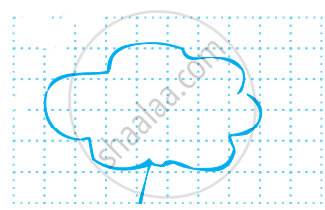
By counting squares, estimate the area of the figure.
Cheggu’s wife asked him to make a circle with the wire. She knew it had an area of 800 square meters.
- Why did Cheggu not choose a rectangle? Explain.
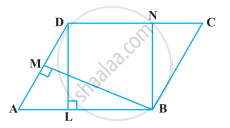
In the following figure, the area of parallelogram ABCD is ______.
Whose footprint is larger - yours or your friend’s?
Is the area of both your footprints the same?
Find the area of the following figure by counting squares: