Advertisements
Advertisements
Question
If ABC and BDE are two equilateral triangles such that D is the mid-point of BC, then find ar (ΔABC) : ar (ΔBDE).
Advertisements
Solution
Given: (1) ΔABC is equilateral triangle.
(2) ΔBDE is equilateral triangle.
(3) D is the midpoint of BC.
To find: ar (Δ ABC ) : ar (ΔBDE)
PROOF : Let us draw the figure as per the instruction given in the question.
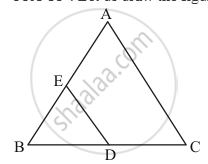
We know that area of equilateral triangle = `sqrt(3)/4 xx a^2`, where a is the side of the triangle.
Let us assume that length of BC is a cm.
This means that length of BD is `a/2` cm, Since D is the midpoint of BC.
∴ area of equilateral Δ ABC =`sqrt(3)/4 xx a^2` ------(1)
area of equilateral ΔBDE = `sqrt(3)/4 xx (a/2)^2` ------(2)
Now, ar(ΔABC) : ar(ΔBDE) =` sqrt(3)/4 xx a^2 : sqrt(3)/4 xx (a/2)^2` (from 1 and 2)
= 4 : 1
Hence we get the result ar(ΔABC) : ar(ΔBDE) = 4 : 1
APPEARS IN
RELATED QUESTIONS
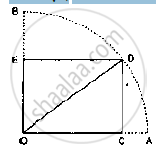
In the below fig. OCDE is a rectangle inscribed in a quadrant of a circle of radius 10 cm. If
OE = 2√5, find the area of the rectangle.
ABCD is a parallelogram. P is any point on CD. If ar (ΔDPA) = 15 cm2 and ar (ΔAPC) = 20 cm2, then ar (ΔAPB) =
Find the area of a square, whose side is: 4.5 cm.
The side of a square field is 16 m. What will be increase in its area, if each of its sides is doubled?
The table given below contains some measures of the rectangle. Find the unknown values.
| Length | Breadth | Perimeter | Area |
| 13 cm | ? | 54 cm | ? |
In the same way, find the area of piece B.
Measure the length of the floor of your classroom in meters. Also, measure the width.
- So how many children can sit in one square meter?
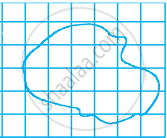
Find the area of the following figure by counting squares:

Find the area of the following figure by counting squares:

Find the area of the following figure by counting squares: