Advertisements
Advertisements
Question
In the following figure, ABC is a right triangle right angled at A. BCED, ACFG and ABMN are squares on the sides BC, CA and AB respectively. Line segment AX ⊥ DE meets BC at Y. Show that:-
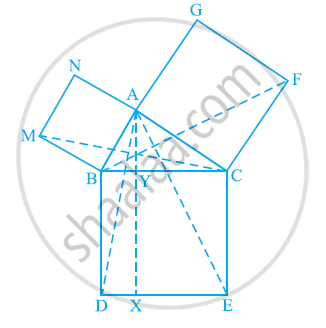
(i) ΔMBC ≅ ΔABD
(ii) ar (BYXD) = 2 ar(MBC)
(iii) ar (BYXD) = ar(ABMN)
(iv) ΔFCB ≅ ΔACE
(v) ar(CYXE) = 2 ar(FCB)
(vi) ar (CYXE) = ar(ACFG)
(vii) ar (BCED) = ar(ABMN) + ar(ACFG)
Note : Result (vii) is the famous Theorem of Pythagoras. You shall learn a simpler proof of this theorem in Class X.
Advertisements
Solution
(i) We know that each angle of a square is 90°.
Hence, ∠ABM = ∠DBC = 90º
⇒ ∠ABM + ∠ABC = ∠DBC + ∠ABC
⇒ ∠MBC = ∠ABD
In ΔMBC and ΔABD,
∠MBC = ∠ABD (Proved above)
MB = AB (Sides of square ABMN)
BC = BD (Sides of square BCED)
∴ ΔMBC ≅ ΔABD (SAS congruence rule)
(ii) We have
ΔMBC ≅ ΔABD
⇒ ar (ΔMBC) = ar (ΔABD) ... (1)
It is given that AX ⊥ DE and BD ⊥ DE (Adjacent sides of square
BDEC)
⇒ BD || AX (Two lines perpendicular to same line are parallel to each other)
ΔABD and parallelogram BYXD are on the same base BD and between the same parallels BD and AX.
∴ ar(ΔABD) = 1/2ar(BYXD)
ar(BYXD) = 2ar(ΔABD)
Area (BYXD) = 2 area (ΔMBC) [Using equation (1)] ... (2)
(iii) ΔMBC and parallelogram ABMN are lying on the same base MB and between same parallels MB and NC.
∴ ar(ΔMBC) = 1/2ar(ABMN)
2ar (ΔMBC) = ar (ABMN)
ar (BYXD) = ar (ABMN) [Using equation (2)] ... (3)
(iv) We know that each angle of a square is 90°.
∴ ∠FCA = ∠BCE = 90º
⇒ ∠FCA + ∠ACB = ∠BCE + ∠ACB
⇒ ∠FCB = ∠ACE
In ΔFCB and ΔACE,
∠FCB = ∠ACE
FC = AC (Sides of square ACFG)
CB = CE (Sides of square BCED)
ΔFCB ≅ ΔACE (SAS congruence rule)
(v) It is given that AX ⊥ DE and CE ⊥ DE (Adjacent sides of square BDEC)
Hence, CE || AX (Two lines perpendicular to the same line are parallel to each other)
Consider ΔACE and parallelogram CYXE
ΔACE and parallelogram CYXE are on the same base CE and between the same parallels CE and AX.
∴ ar(ΔACE) = 1/2ar(CYXE)
⇒ ar(CYXE) = 2 ar(ΔACE) ... (4)
We had proved that
∴ ΔFCB ≅ ΔACE
ar (ΔFCB) ≅ ar (ΔACE) ... (5)
On comparing equations (4) and (5), we obtain
ar (CYXE) = 2 ar (ΔFCB) ... (6)
(vi) Consider ΔFCB and parallelogram ACFG
ΔFCB and parallelogram ACFG are lying on the same base CF and between the same parallels CF and BG.
∴ ar(ΔFCB) = 1/2 ar(ACFG)
⇒ ar(ACFG) = 2 ar(ΔFCB)
⇒ ar (ACFG) = ar (CYXE) [Using equation (6)] ... (7)
(vii) From the figure, it is evident that
ar (BCED) = ar (BYXD) + ar (CYXE)
⇒ ar (BCED) = ar (ABMN) + ar (ACFG) [Using equations (3) and (7)]
APPEARS IN
RELATED QUESTIONS
Show that the diagonals of a parallelogram divide it into four triangles of equal area.
In the given figure, ABC and ABD are two triangles on the same base AB. If line-segment CD is bisected by AB at O, show that ar (ABC) = ar (ABD).

D, E and F are respectively the mid-points of the sides BC, CA and AB of a ΔABC. Show that
(i) BDEF is a parallelogram.
(ii) ar (DEF) = 1/4ar (ABC)
(iii) ar (BDEF) = 1/2ar (ABC)
In the given figure, ABCDE is a pentagon. A line through B parallel to AC meets DC produced at F. Show that
(i) ar (ACB) = ar (ACF)
(ii) ar (AEDF) = ar (ABCDE)

ABCD is a trapezium with AB || DC. A line parallel to AC intersects AB at X and BC at Y. Prove that ar (ADX) = ar (ACY).
[Hint: Join CX.]
In Fig. below, ABC and BDE are two equilateral triangles such that D is the mid-point of
BC. AE intersects BC in F. Prove that
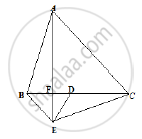
(1) ar (Δ BDE) = `1/2` ar (ΔABC)
(2) Area ( ΔBDE) `= 1/2 ` ar (ΔBAE)
(3) ar (BEF) = ar (ΔAFD)
(4) area (Δ ABC) = 2 area (ΔBEC)
(5) ar (ΔFED) `= 1/8` ar (ΔAFC)
(6) ar (Δ BFE) = 2 ar (ΔEFD)
In a ΔABC, if L and M are points on AB and AC respectively such that LM || BC. Prove
that:
(1) ar (ΔLCM ) = ar (ΔLBM )
(2) ar (ΔLBC) = ar (ΔMBC)
(3) ar (ΔABM) ar (ΔACL)
(4) ar (ΔLOB) ar (ΔMOC)
If a triangle and a parallelogram are on the same base and between same parallels, then the ratio of the area of the triangle to the area of parallelogram is ______.
A point E is taken on the side BC of a parallelogram ABCD. AE and DC are produced to meet at F. Prove that ar (ADF) = ar (ABFC)
In the following figure, ABCDE is any pentagon. BP drawn parallel to AC meets DC produced at P and EQ drawn parallel to AD meets CD produced at Q. Prove that ar (ABCDE) = ar (APQ)