Advertisements
Advertisements
Question
A point E is taken on the side BC of a parallelogram ABCD. AE and DC are produced to meet at F. Prove that ar (ADF) = ar (ABFC)
Advertisements
Solution
Given in the question, A point E is taken on the side BC of a parallelogram ABCD. AE and DC are produced to meet at F.
Prove that ar (ADF) = ar (ABFC)
Proof: ABCD is a parallelogram and AC divides it into two triangle of equal area.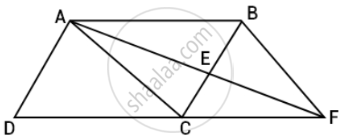
ar (ΔADC) = ar (ΔABC) ...(I)
So, DC || AB and CF || AB
As we know that triangle on the same base and between the same parallels are equal in area.
So, ar (ΔACF) = ar (ΔBCF) ...(II)
Adding equation (I) and (II), we get
ar (ΔADC) + ar (ACF) = ar (ΔABC) + ar (ΔBCF)
ar (ΔADF) = ar (ABFC)
Hence proved.
APPEARS IN
RELATED QUESTIONS
D, E and F are respectively the mid-points of the sides BC, CA and AB of a ΔABC. Show that
(i) BDEF is a parallelogram.
(ii) ar (DEF) = 1/4ar (ABC)
(iii) ar (BDEF) = 1/2ar (ABC)
ABCD is a trapezium with AB || DC. A line parallel to AC intersects AB at X and BC at Y. Prove that ar (ADX) = ar (ACY).
[Hint: Join CX.]
In the given figure, ar (DRC) = ar (DPC) and ar (BDP) = ar (ARC). Show that both the quadrilaterals ABCD and DCPR are trapeziums.
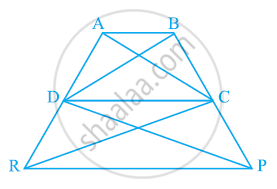
If a triangle and a parallelogram are on the same base and between same parallels, then the ratio of the area of the triangle to the area of parallelogram is ______.
ABC and BDE are two equilateral triangles such that D is the mid-point of BC. Then ar (BDE) = `1/4` ar (ABC).
The area of the parallelogram ABCD is 90 cm2 (see figure). Find
- ar (ΔABEF)
- ar (ΔABD)
- ar (ΔBEF)
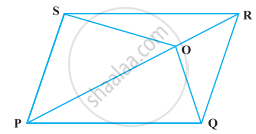
O is any point on the diagonal PR of a parallelogram PQRS (Figure). Prove that ar (PSO) = ar (PQO).
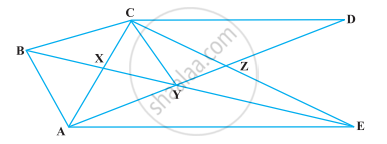
In the following figure, CD || AE and CY || BA. Prove that ar (CBX) = ar (AXY).
In ∆ABC, if L and M are the points on AB and AC, respectively such that LM || BC. Prove that ar (LOB) = ar (MOC)
In the following figure, ABCDE is any pentagon. BP drawn parallel to AC meets DC produced at P and EQ drawn parallel to AD meets CD produced at Q. Prove that ar (ABCDE) = ar (APQ)