Advertisements
Advertisements
Question
A villager Itwaari has a plot of land of the shape of a quadrilateral. The Gram Panchayat of the village decided to take over some portion of his plot from one of the corners to construct a Health Centre. Itwaari agrees to the above proposal with the condition that he should be given equal amount of land in lieu of his land adjoining his plot so as to form a triangular plot. Explain how this proposal will be implemented.
Advertisements
Solution
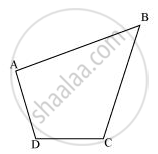
Let quadrilateral ABCD be the original shape of the field.
The proposal may be implemented as follows.
Join diagonal BD and draw a line parallel to BD through point A. Let it meet
the extended side CD of ABCD at point E. Join BE and AD. Let them intersect each other at O. Then, portion ΔAOB can be cut from the original field so that the new shape of the field will be ΔBCE. (See figure)
We have to prove that the area of ΔAOB (portion that was cut so as to construct Health Centre) is equal to the area of ΔDEO (portion added to the field so as to make the area of the new field so formed equal to the area of the original field)
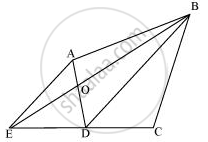
It can be observed that ΔDEB and ΔDAB lie on the same base BD and are between the same parallels BD and AE.
∴ Area (ΔDEB) = Area (ΔDAB)
⇒ Area (ΔDEB) − Area (ΔDOB) = Area (ΔDAB) − Area (ΔDOB)
⇒ Area (ΔDEO) = Area (ΔAOB)
RELATED QUESTIONS
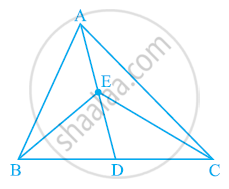
In the given figure, E is any point on median AD of a ΔABC. Show that ar (ABE) = ar (ACE)
D and E are points on sides AB and AC respectively of ΔABC such that
ar (DBC) = ar (EBC). Prove that DE || BC.
Diagonals AC and BD of a trapezium ABCD with AB || DC intersect each other at O. Prove that ar (AOD) = ar (BOC).
Diagonals AC and BD of a quadrilateral ABCD intersect at O in such a way that ar (AOD) = ar (BOC). Prove that ABCD is a trapezium.
In a ΔABC, P and Q are respectively the mid-points of AB and BC and R is the mid-point
of AP. Prove that :
(1) ar (Δ PBQ) = ar (Δ ARC)
(2) ar (Δ PRQ) =`1/2`ar (Δ ARC)
(3) ar (Δ RQC) =`3/8` ar (Δ ABC) .
If a triangle and a parallelogram are on the same base and between same parallels, then the ratio of the area of the triangle to the area of parallelogram is ______.
The area of the parallelogram ABCD is 90 cm2 (see figure). Find
- ar (ΔABEF)
- ar (ΔABD)
- ar (ΔBEF)
A point E is taken on the side BC of a parallelogram ABCD. AE and DC are produced to meet at F. Prove that ar (ADF) = ar (ABFC)
The medians BE and CF of a triangle ABC intersect at G. Prove that the area of ∆GBC = area of the quadrilateral AFGE.
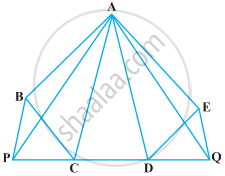
In the following figure, ABCDE is any pentagon. BP drawn parallel to AC meets DC produced at P and EQ drawn parallel to AD meets CD produced at Q. Prove that ar (ABCDE) = ar (APQ)