Advertisements
Advertisements
Question
In a ΔABC, if L and M are points on AB and AC respectively such that LM || BC. Prove
that:
(1) ar (ΔLCM ) = ar (ΔLBM )
(2) ar (ΔLBC) = ar (ΔMBC)
(3) ar (ΔABM) ar (ΔACL)
(4) ar (ΔLOB) ar (ΔMOC)
Advertisements
Solution
(1) Clearly Triangles LMB and LMC are on the same base LM and between the same
parallels LM and BC.
∴ ar (ΔLMB) = ar (ΔLMC) ......(1)
(2) We observe that triangles LBC and MBC area on the same base BC and between the
same parallels LM and BC
∴ arc ΔLBC = ar (MBC) ..........(2)
(3) We have
ar (ΔLMB) = ar (ΔLMC) [from (1)]
⇒ ar ( ΔALM) + ar (ΔLMB) = ar (ΔALM) + ar (LMC)
⇒ ar (ΔABM) = ar (ΔACL)
(4) We have
ar(ΔCBC) = ar (ΔMBC) ∴ [from (1)]
⇒ ar (ΔLBC) = ar (ΔBOC) = a (ΔMBC) - ar (BOC)
⇒ ar (ΔLOB) = ar (ΔMOC)
APPEARS IN
RELATED QUESTIONS
In a triangle ABC, E is the mid-point of median AD. Show that ar (BED) = 1/4ar (ABC).
In the following figure, ABC and BDE are two equilateral triangles such that D is the mid-point of BC. If AE intersects BC at F, show that
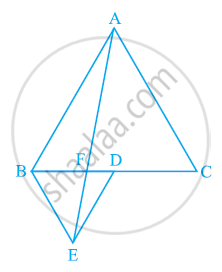
(i) ar (BDE) = 1/4 ar (ABC)
(ii) ar (BDE) = 1/2 ar (BAE)
(iii) ar (ABC) = 2 ar (BEC)
(iv) ar (BFE) = ar (AFD)
(v) ar (BFE) = 2 ar (FED)
(vi) ar (FED) = 1/8 ar (AFC)
[Hint : Join EC and AD. Show that BE || AC and DE || AB, etc.]
ABCD is a parallelogram and X is the mid-point of AB. If ar (AXCD) = 24 cm2, then ar (ABC) = 24 cm2.
PQRS is a parallelogram whose area is 180 cm2 and A is any point on the diagonal QS. The area of ∆ASR = 90 cm2.
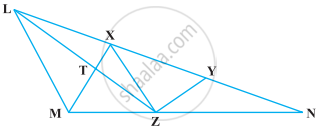
X and Y are points on the side LN of the triangle LMN such that LX = XY = YN. Through X, a line is drawn parallel to LM to meet MN at Z (See figure). Prove that ar (LZY) = ar (MZYX)
The area of the parallelogram ABCD is 90 cm2 (see figure). Find ar (ΔABD)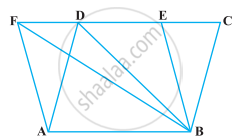
The area of the parallelogram ABCD is 90 cm2 (see figure). Find ar (ΔBEF)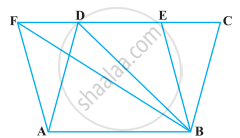
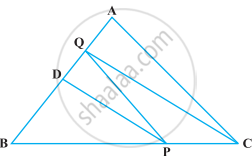
In ∆ABC, D is the mid-point of AB and P is any point on BC. If CQ || PD meets AB in Q (Figure), then prove that ar (BPQ) = `1/2` ar (∆ABC).
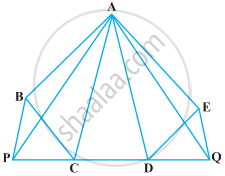
In the following figure, ABCDE is any pentagon. BP drawn parallel to AC meets DC produced at P and EQ drawn parallel to AD meets CD produced at Q. Prove that ar (ABCDE) = ar (APQ)
If the medians of a ∆ABC intersect at G, show that ar (AGB) = ar (AGC) = ar (BGC) = `1/3` ar (ABC)
