Advertisements
Advertisements
Question
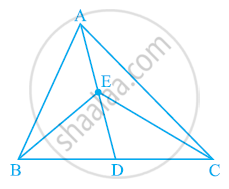
In the given figure, E is any point on median AD of a ΔABC. Show that ar (ABE) = ar (ACE)
Advertisements
Solution
AD is the median of ΔABC. Therefore, it will divide ΔABC into two triangles of equal areas.
∴ Area (ΔABD) = Area (ΔACD) ... (1)
ED is the median of ΔEBC.
∴ Area (ΔEBD) = Area (ΔECD) ... (2)
On subtracting equation (2) from equation (1), we obtain
Area (ΔABD) − Area (EBD) = Area (ΔACD) − Area (ΔECD)
Area (ΔABE) = Area (ΔACE)
RELATED QUESTIONS
Show that the diagonals of a parallelogram divide it into four triangles of equal area.
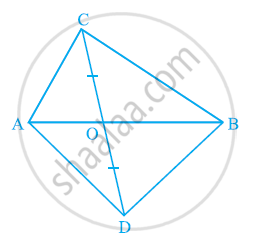
In the given figure, ABC and ABD are two triangles on the same base AB. If line-segment CD is bisected by AB at O, show that ar (ABC) = ar (ABD).
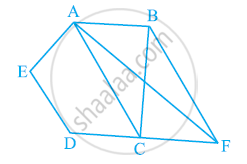
In the given figure, ABCDE is a pentagon. A line through B parallel to AC meets DC produced at F. Show that
(i) ar (ACB) = ar (ACF)
(ii) ar (AEDF) = ar (ABCDE)
ABCD is a trapezium with AB || DC. A line parallel to AC intersects AB at X and BC at Y. Prove that ar (ADX) = ar (ACY).
[Hint: Join CX.]
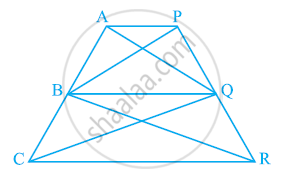
In the given figure, AP || BQ || CR. Prove that ar (AQC) = ar (PBR).
If a triangle and a parallelogram are on the same base and between same parallels, then the ratio of the area of the triangle to the area of parallelogram is ______.
The area of the parallelogram ABCD is 90 cm2 (see figure). Find ar (ΔBEF)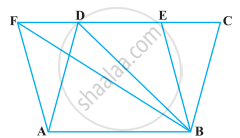
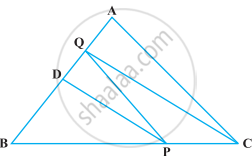
In ∆ABC, D is the mid-point of AB and P is any point on BC. If CQ || PD meets AB in Q (Figure), then prove that ar (BPQ) = `1/2` ar (∆ABC).
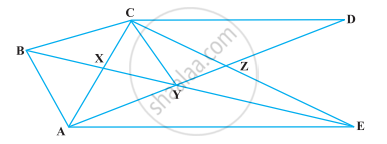
In the following figure, CD || AE and CY || BA. Prove that ar (CBX) = ar (AXY).
If the medians of a ∆ABC intersect at G, show that ar (AGB) = ar (AGC) = ar (BGC) = `1/3` ar (ABC)
