Advertisements
Advertisements
प्रश्न
Find the area and perimeter of the following parallelograms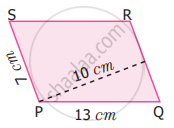
Advertisements
उत्तर
Given: base b = 7 cm
height h = 10 cm
Area of the parallelogram = b × h sq.units
= 7 × 10 cm2
= 70 cm2
Perimeter = Sum of four sides
= 13 cm + 7 cm + 13 cm + 7 cm
= 40 cm
Area = 70 cm2, Perimeter = 40 cm
APPEARS IN
संबंधित प्रश्न
In the given figure, find the area of ΔGEF.
The median of a triangle divides it into two ______.
The side of a square is 3.6 cm; find its area.
Each side of a square is 7 m. If its each side be increased by 3 m, what will be the increase in its area.
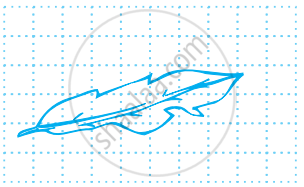
By counting squares, estimate the area of the figure.
Cheggu’s wife asked him to make a circle with the wire. She knew it had an area of 800 square meters.
- Why did Cheggu not choose a rectangle? Explain.
Each line gives a story. You have to choose the question which makes the best story problem. The first one is already marked.
- A shopkeeper has 50 boxes. There are 48 fruits in one box.
Tick the one question which matches with the given problem.
Explain why (a) and (c) are not good choices.a) How much will the shopkeeper pay in all? b) How many fruits are there in all? ✓ c) How many more boxes will he need?
An engineer who plans to build a compound wall on all sides of a house must find the area of the compound.
Find all the possible dimensions (in natural numbers) of a rectangle with a perimeter 36 cm and find their areas.
Find the area of the following figure by counting squares:

