Advertisements
Advertisements
प्रश्न
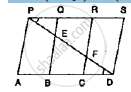
In below fig., PSDA is a parallelogram in which PQ = QR = RS and AP || BQ || CR. Prove
that ar (Δ PQE) = ar (ΔCFD).
Advertisements
उत्तर
Given that PSDA is a parallelogram
Since, AP || BQ ||CR || DS and AD || PS
∴PQ = CD .....(1)
In ΔBED,C is the midpoint of BD and CF || BE
∴ F is the midpoint of ED
⇒ EF = PE
similarly
EF = FD
∴ PE = FD ........ (2)
In Δ SPQE and CFD , WE have
PE = FD
∠EDQ = ∠FDC, [Alternative angles]
And PQ = CD
So by SAS congruence criterion, we have . ΔPQE ≅ ΔDCF .
APPEARS IN
संबंधित प्रश्न
In the given figure, ABCD is a rectangle in which CD = 6 cm, AD = 8 cm. Find the area of parallelogram CDEF.
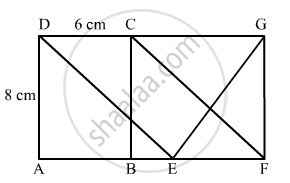
In the given figure, find the area of ΔGEF.
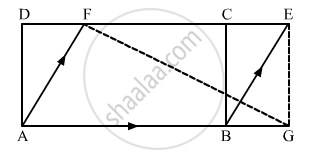
In the given figure, ABCD is a rectangle with sides AB = 10 cm and AD = 5 cm. Find the area of ΔEFG.
PQRS is a trapezium having PS and QR as parallel sides. A is any point on PQ and B is a point on SR such that AB || QR. If area of ΔPBQ is 17cm2, find the area of ΔASR.
The mid-points of the sides of a triangle ABC along with any of the vertices as the fourth point make a parallelogram of area equal to ______.
The side of a square field is 16 m. What will be increase in its area, if each of its sides is increased by 4 m?
The table given below contains some measures of the rectangle. Find the unknown values.
| Length | Breadth | Perimeter | Area |
| 13 cm | ? | 54 cm | ? |
Is the area of the blue shape more than the area of the yellow shape? Why?


In the same way, find the area of piece B.
Measure the length of the floor of your classroom in meters. Also measure the width.
- If you want to move around easily then how many children do you think should be there in one square meter?
