Advertisements
Advertisements
प्रश्न
ABCD is a parallelogram. E is a point on BA such that BE = 2 EA and F is a point on DC
such that DF = 2 FC. Prove that AE CF is a parallelogram whose area is one third of the
area of parallelogram ABCD.
Advertisements
उत्तर
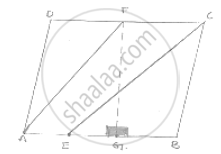
Construction: Draw FG ⊥ AB
Proof: We have
BE = 2EA and DF = 2 FC
⇒ AB - AE = 2EA and DC - FC = 2FC
⇒ AB = 3EA and DC = 3FC
⇒ AE = `1/2` AB and FC = ` 1/3` CD .......... (1)
But AB = DC
Then, AE = DC [opposite sides of ||gm]
Then, AE = FC
Thus, AE = FC and AE || FC.
Then, AECF is a parallelogram
Now ar (||gm = AECF) = AE × FG
⇒ ar (||gm =AECF) =`1/3 ABxx FG ` form ....... (1)
⇒ 3ar (||gm =AECF) = AB × FG ........(2)
and area (||gm =ABCD) = AB × FG ........... (3)
Compare equation (2) and (3)
⇒ 3 ar (||gm =AECF) = area (||gm =ABCD)
⇒ area (||gm =AECF) = `1/3` area (||gm =ABCD)
APPEARS IN
संबंधित प्रश्न
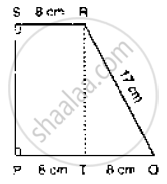
Compute the area of trapezium PQRS is Fig. below.
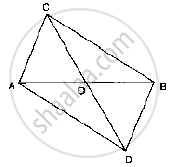
In the below Fig, ABC and ABD are two triangles on the base AB. If line segment CD is
bisected by AB at O, show that ar (Δ ABC) = ar (Δ ABD)
In a ΔABC, D, E, F are the mid-points of sides BC, CA and AB respectively. If ar (ΔABC) = 16cm2, then ar (trapezium FBCE) =
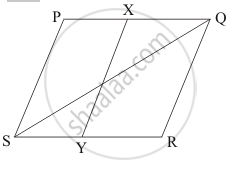
In the given figure, PQRS is a parallelogram. If X and Y are mid-points of PQ and SRrespectively and diagonal Q is joined. The ratio ar (||gm XQRY) : ar (ΔQSR) =
Find the area of a rectangle whose length = 15 cm breadth = 6.4 cm
The side of a square field is 16 m. What will be increase in its area, if each of its sides is increased by 4 m?
How will you decide? Discuss.
Is the area of both your footprints the same?
Which unit is used to express area?
If a figure contains only 8 fully-filled squares and no partial squares, what is its area?
