Advertisements
Advertisements
प्रश्न
ABCD is a parallelogram. E is a point on BA such that BE = 2 EA and F is a point on DC
such that DF = 2 FC. Prove that AE CF is a parallelogram whose area is one third of the
area of parallelogram ABCD.
Advertisements
उत्तर
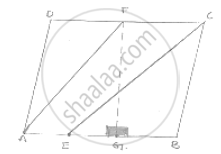
Construction: Draw FG ⊥ AB
Proof: We have
BE = 2EA and DF = 2 FC
⇒ AB - AE = 2EA and DC - FC = 2FC
⇒ AB = 3EA and DC = 3FC
⇒ AE = `1/2` AB and FC = ` 1/3` CD .......... (1)
But AB = DC
Then, AE = DC [opposite sides of ||gm]
Then, AE = FC
Thus, AE = FC and AE || FC.
Then, AECF is a parallelogram
Now ar (||gm = AECF) = AE × FG
⇒ ar (||gm =AECF) =`1/3 ABxx FG ` form ....... (1)
⇒ 3ar (||gm =AECF) = AB × FG ........(2)
and area (||gm =ABCD) = AB × FG ........... (3)
Compare equation (2) and (3)
⇒ 3 ar (||gm =AECF) = area (||gm =ABCD)
⇒ area (||gm =AECF) = `1/3` area (||gm =ABCD)
APPEARS IN
संबंधित प्रश्न
In Q. No 1, if AD = 6 cm, CF = 10 cm, and AE = 8cm, find AB.
ABCD is a parallelogram whose diagonals AC and BD intersect at O. A line through O
intersects AB at P and DC at Q. Prove that ar (Δ POA) = ar (Δ QOC).
In square ABCD, P and Q are mid-point of AB and CD respectively. If AB = 8cm and PQand BD intersect at O, then find area of ΔOPB.
Two parallelograms are on the same base and between the same parallels. The ratio of their areas is
If AD is median of ΔABC and P is a point on AC such that
ar (ΔADP) : ar (ΔABD) = 2 : 3, then ar (Δ PDC) : ar (Δ ABC)
Who had the bigger piece? How much bigger?
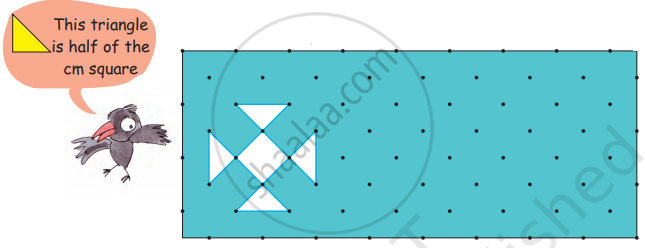
How many tiles like the triangle given here will fit in the white design?
Area of design = ________ square cm
Is the area of your belt the same as the area of the postcard? Why or why not?
Measure the length of the floor of your classroom in meters. Also, measure the width.
- What is the area of the floor of your classroom in square metres?
The King was very happy with carpenters Cheggu and Anar. They had made a very big and beautiful bed for him. So as gifts the king wanted to give some land to Cheggu, and some gold to Anar. Cheggu was happy. He took 100 meters of wire and tried to make different rectangles.
He made a 10 m × 40 m rectangle. Its area was 400 square meters. So he next made a 30 m × 20 m rectangle.
- What is its area? Is it more than the first rectangle?
