Advertisements
Advertisements
प्रश्न
In a ΔABC, P and Q are respectively the mid-points of AB and BC and R is the mid-point
of AP. Prove that :
(1) ar (Δ PBQ) = ar (Δ ARC)
(2) ar (Δ PRQ) =`1/2`ar (Δ ARC)
(3) ar (Δ RQC) =`3/8` ar (Δ ABC) .
Advertisements
उत्तर
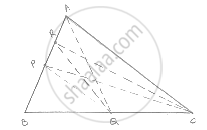
(1) We know that each median of a Δle divides it into two triangles of equal area
Since, OR is a median of ΔCAP
∴ ar (ΔCRA) = `1/2` ar (ΔCAP) ....... (1)
Also, CPis a median of ΔCAB
∴ ar ( ΔCAP) ar (ΔCPB) ....... (2)
From (1) and (2) we get
∴ area (Δ ARC ) = `1/2 ar (CPB)` ....... (3)
PQ is the median of ΔPBC
∴ area( Δ CPB) = 2area (Δ PBQ) ......... (4)
From (3) and (4) we get
∴ area (Δ ARC) = area (PBQ) ....... (5)
(2) Since QP and QR medians of s QAB and QAP respectively.
∴ ar (ΔQAP) = area (ΔPBQ) ............ (6)
And area (ΔQAP) = 2ar (QRP) ......... (7)
From (6) and (7) we have
Area (ΔPRQ) = `1/2` ar (ΔPBQ) ......... (8)
From (5) and (8) we get
Area (ΔPRQ) = `1/2` area (ΔARC)
(3) Since, ∠R is a median of ΔCAP
∴ area (ΔARC) = `1/2` ar (ΔCAP)
`= 1/2 xx1/2[ ar (ABC)]`
= `1/4` area (ABC)
Since RQ is a median of ΔRBC
∴ ar (ΔRQC) =`1/2` ar (Δ RBC)
= `1/2`[ ar (ΔABC)- ar (ARC) ]
= `1/2`[ar (ΔABC) - `1/4`(Δ ABC )]
= `3/8`(Δ ABC)
APPEARS IN
संबंधित प्रश्न
Diagonals AC and BD of a quadrilateral ABCD intersect at O in such a way that ar (AOD) = ar (BOC). Prove that ABCD is a trapezium.
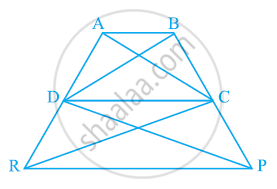
In the given figure, ar (DRC) = ar (DPC) and ar (BDP) = ar (ARC). Show that both the quadrilaterals ABCD and DCPR are trapeziums.
In the following figure, ABC and BDE are two equilateral triangles such that D is the mid-point of BC. If AE intersects BC at F, show that

(i) ar (BDE) = 1/4 ar (ABC)
(ii) ar (BDE) = 1/2 ar (BAE)
(iii) ar (ABC) = 2 ar (BEC)
(iv) ar (BFE) = ar (AFD)
(v) ar (BFE) = 2 ar (FED)
(vi) ar (FED) = 1/8 ar (AFC)
[Hint : Join EC and AD. Show that BE || AC and DE || AB, etc.]
In Fig. below, ABC and BDE are two equilateral triangles such that D is the mid-point of
BC. AE intersects BC in F. Prove that
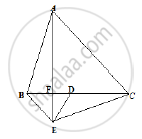
(1) ar (Δ BDE) = `1/2` ar (ΔABC)
(2) Area ( ΔBDE) `= 1/2 ` ar (ΔBAE)
(3) ar (BEF) = ar (ΔAFD)
(4) area (Δ ABC) = 2 area (ΔBEC)
(5) ar (ΔFED) `= 1/8` ar (ΔAFC)
(6) ar (Δ BFE) = 2 ar (ΔEFD)
In a ΔABC, if L and M are points on AB and AC respectively such that LM || BC. Prove
that:
(1) ar (ΔLCM ) = ar (ΔLBM )
(2) ar (ΔLBC) = ar (ΔMBC)
(3) ar (ΔABM) ar (ΔACL)
(4) ar (ΔLOB) ar (ΔMOC)
In the following figure, ABCD and EFGD are two parallelograms and G is the mid-point of CD. Then ar (DPC) = `1/2` ar (EFGD).
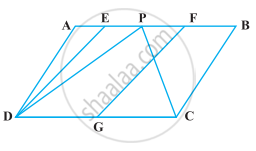
The area of the parallelogram ABCD is 90 cm2 (see figure). Find ar (ΔBEF)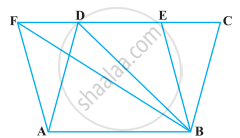
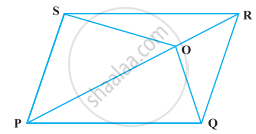
O is any point on the diagonal PR of a parallelogram PQRS (Figure). Prove that ar (PSO) = ar (PQO).
A point E is taken on the side BC of a parallelogram ABCD. AE and DC are produced to meet at F. Prove that ar (ADF) = ar (ABFC)
In ∆ABC, if L and M are the points on AB and AC, respectively such that LM || BC. Prove that ar (LOB) = ar (MOC)
