Advertisements
Advertisements
प्रश्न
In the following figure, X and Y are the mid-points of AC and AB respectively, QP || BC and CYQ and BXP are straight lines. Prove that ar (ABP) = ar (ACQ).

Advertisements
उत्तर
Given: X and Y are the mid-points of AC and AB respectively. Also, QP || BC and CYQ, BXP are straight lines.
To prove: ar (ΔABP) = ar (ΔACQ)
Proof: Since, X and Y are the mid-points of AC and AB respectively.
So, XY || BC
We know that, triangles on the same base and between the same parallels are equal in area.
Here, ΔBYC and ΔBXC lie on same base BC and between the same parallels BC and XY.
So, ar (ΔBYC) = ar (ΔBXC)
On subtracting ar (ΔBOC) from both sides, we get
ar (ΔBYC) – ar (ΔBOC) = ar (ΔBXC) – ar (ΔBOC)
=» ar (ΔBOY) = ar (ΔCOX)
On adding ar (ΔXOY) both sides, we get
ar (ΔSOY) + ar (ΔXOY) = ar (ΔCOX) + ar (ΔXOY)
⇒ ar (ΔBYX) = ar (ΔCXY) ...(i)
Hence, we observe that quadrilaterals XYAP and YXAQ are on the same base XY and between the same parallels XY and PQ.
ar (XYAP) = ar (YXAQ) ...(ii)
On adding equations (i) and (ii), we get
ar (ΔBYX) + ar (XYAP) = ar (ΔCXY) + ar (YXAQ)
⇒ ar (ΔABP) = ar (ΔACQ)
Hence proved.
APPEARS IN
संबंधित प्रश्न
D, E and F are respectively the mid-points of the sides BC, CA and AB of a ΔABC. Show that
(i) BDEF is a parallelogram.
(ii) ar (DEF) = 1/4ar (ABC)
(iii) ar (BDEF) = 1/2ar (ABC)
D and E are points on sides AB and AC respectively of ΔABC such that
ar (DBC) = ar (EBC). Prove that DE || BC.
XY is a line parallel to side BC of a triangle ABC. If BE || AC and CF || AB meet XY at E and F respectively, show that
ar (ABE) = ar (ACF)
The side AB of a parallelogram ABCD is produced to any point P. A line through A and parallel to CP meets CB produced at Q and then parallelogram PBQR is completed (see the following figure). Show that
ar (ABCD) = ar (PBQR).
[Hint: Join AC and PQ. Now compare area (ACQ) and area (APQ)]

Diagonals AC and BD of a trapezium ABCD with AB || DC intersect each other at O. Prove that ar (AOD) = ar (BOC).
In the given figure, ABCDE is a pentagon. A line through B parallel to AC meets DC produced at F. Show that
(i) ar (ACB) = ar (ACF)
(ii) ar (AEDF) = ar (ABCDE)

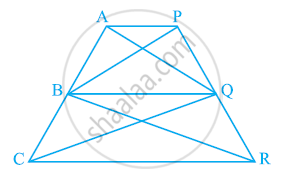
In the given figure, AP || BQ || CR. Prove that ar (AQC) = ar (PBR).
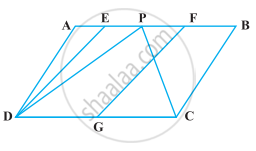
In the following figure, ABCD and EFGD are two parallelograms and G is the mid-point of CD. Then ar (DPC) = `1/2` ar (EFGD).
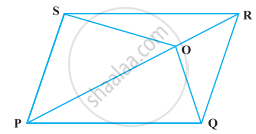
O is any point on the diagonal PR of a parallelogram PQRS (Figure). Prove that ar (PSO) = ar (PQO).
If the medians of a ∆ABC intersect at G, show that ar (AGB) = ar (AGC) = ar (BGC) = `1/3` ar (ABC)
