Advertisements
Advertisements
प्रश्न
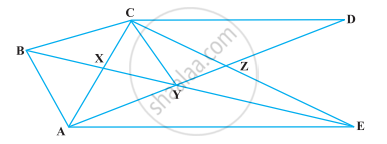
In the following figure, CD || AE and CY || BA. Prove that ar (CBX) = ar (AXY).
Advertisements
उत्तर
Given: In the following figure, CD || AE and CY || BA
To prove: ar (ΔCBX) = ar (ΔAXY) .
Proof: We know that, triangles on the same base and between the same parallels are equal in areas.
Here, ΔABY and ΔABC both lie on the same base AB and between the same parallels CY and BA.
ar (ΔABY) = ar (ΔABC)
⇒ ar (ABX) + ar (AXY) = ar (ABX) + ar (CBX)
⇒ ar (AXY) = ar (CBX) ...[Eliminating ar (ABX) from both sides]
APPEARS IN
संबंधित प्रश्न
In the given figure, ABC and ABD are two triangles on the same base AB. If line-segment CD is bisected by AB at O, show that ar (ABC) = ar (ABD).

D, E and F are respectively the mid-points of the sides BC, CA and AB of a ΔABC. Show that
(i) BDEF is a parallelogram.
(ii) ar (DEF) = 1/4ar (ABC)
(iii) ar (BDEF) = 1/2ar (ABC)
XY is a line parallel to side BC of a triangle ABC. If BE || AC and CF || AB meet XY at E and F respectively, show that
ar (ABE) = ar (ACF)
In the given figure, AP || BQ || CR. Prove that ar (AQC) = ar (PBR).

Diagonals AC and BD of a quadrilateral ABCD intersect at O in such a way that ar (AOD) = ar (BOC). Prove that ABCD is a trapezium.
If a triangle and a parallelogram are on the same base and between same parallels, then the ratio of the area of the triangle to the area of parallelogram is ______.
ABC and BDE are two equilateral triangles such that D is the mid-point of BC. Then ar (BDE) = `1/4` ar (ABC).
The area of the parallelogram ABCD is 90 cm2 (see figure). Find ar (ΔABD)
O is any point on the diagonal PR of a parallelogram PQRS (Figure). Prove that ar (PSO) = ar (PQO).

In the following figure, X and Y are the mid-points of AC and AB respectively, QP || BC and CYQ and BXP are straight lines. Prove that ar (ABP) = ar (ACQ).

