Advertisements
Advertisements
प्रश्न
ABCD is a trapezium in which AB || DC, DC = 30 cm and AB = 50 cm. If X and Y are, respectively the mid-points of AD and BC, prove that ar (DCYX) = `7/9` ar (XYBA)
Advertisements
उत्तर
Given: In a trapezium ABCD, AB || DC, DC = 30 cm and AB = 50 cm.
Also, X and Y are respectively the mid-points of AD and BC.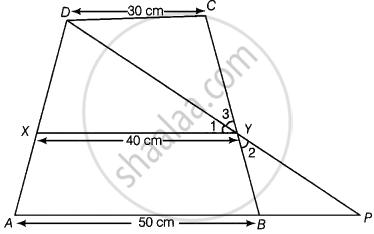
To prove: `ar (DCYX) = 7/9 ar (XYBA)`
Construction: Join DY and extend it to meet produced AB at P.
Proof: In ΔDCY and ΔPBY,
CY = BY ...[Since, Y is the mid-point of BC]
∠DCY = ∠PBY ...[Alternate interior angles]
And ∠2 = ∠3 ...[Vertically opposite angles]
∴ ΔDCY ≅ ΔPBY ...[By ASA congruence rule]
Then, DC = BP ...[By CPCT]
But DC = 30 cm ...[Given]
∴ DC = BP = 30 cm
Now, AP = AB + BP
= 50 + 30
= 80 cm
In ΔADP, by mid-point theorem,
`XY = 1/2 AP`
= `1/2 xx 80`
= 40 cm
Let distance between AB, XY and XY, DC is h cm.
Now, area of trapezium `DCYX = 1/2 h (30 + 40)` ...[∵ Area of trapezium = `1/2` sum of parallel sides × distance between them]
= `1/2 h (70)`
= 35 h cm2
Similarly, area of trapezium XYBA
= `1/2 h (40 + 50)`
= `1/2 h xx 90`
= 45 h cm2
∴ `(ar (DCYX))/(ar (XYBA)) = (35h)/(45h) = 7/9`
⇒ `ar (DCYX) = 7/9 ar (XYBA)`
Hence proved.
APPEARS IN
संबंधित प्रश्न
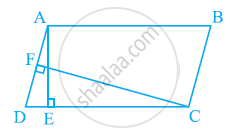
In the given figure, ABCD is parallelogram, AE ⊥ DC and CF ⊥ AD. If AB = 16 cm, AE = 8 cm and CF = 10 cm, find AD.
If E, F, G and H are respectively the mid-points of the sides of a parallelogram ABCD show that ar (EFGH) = 1/2ar (ABCD)
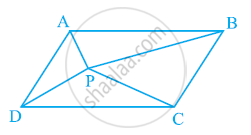
In the given figure, P is a point in the interior of a parallelogram ABCD. Show that
(i) ar (APB) + ar (PCD) = 1/2ar (ABCD)
(ii) ar (APD) + ar (PBC) = ar (APB) + ar (PCD)
[Hint: Through. P, draw a line parallel to AB]
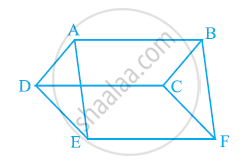
In the following figure, ABCD, DCFE and ABFE are parallelograms. Show that ar (ADE) = ar (BCF).
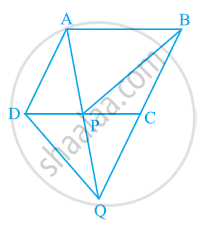
In the following figure, ABCD is parallelogram and BC is produced to a point Q such that AD = CQ. If AQ intersect DC at P, show that
ar (BPC) = ar (DPQ).
[Hint: Join AC.]
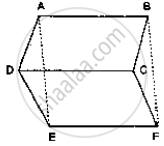
In the given below fig. ABCD, ABFE and CDEF are parallelograms. Prove that ar (ΔADE)
= ar (ΔBCF)
In which of the following figures, you find two polygons on the same base and between the same parallels?
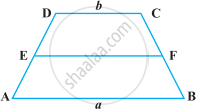
ABCD is a trapezium with parallel sides AB = a cm and DC = b cm (Figure). E and F are the mid-points of the non-parallel sides. The ratio of ar (ABFE) and ar (EFCD) is ______.
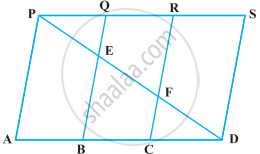
In the following figure, PSDA is a parallelogram. Points Q and R are taken on PS such that PQ = QR = RS and PA || QB || RC. Prove that ar (PQE) = ar (CFD).
ABCD is a parallelogram in which BC is produced to E such that CE = BC (Figure). AE intersects CD at F. If ar (DFB) = 3 cm2, find the area of the parallelogram ABCD.
