Advertisements
Advertisements
Question
ABCD is a trapezium in which AB || DC, DC = 30 cm and AB = 50 cm. If X and Y are, respectively the mid-points of AD and BC, prove that ar (DCYX) = `7/9` ar (XYBA)
Advertisements
Solution
Given: In a trapezium ABCD, AB || DC, DC = 30 cm and AB = 50 cm.
Also, X and Y are respectively the mid-points of AD and BC.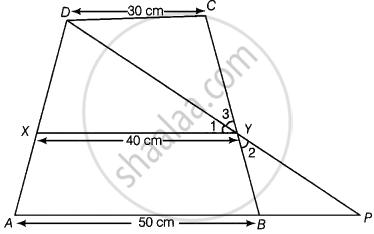
To prove: `ar (DCYX) = 7/9 ar (XYBA)`
Construction: Join DY and extend it to meet produced AB at P.
Proof: In ΔDCY and ΔPBY,
CY = BY ...[Since, Y is the mid-point of BC]
∠DCY = ∠PBY ...[Alternate interior angles]
And ∠2 = ∠3 ...[Vertically opposite angles]
∴ ΔDCY ≅ ΔPBY ...[By ASA congruence rule]
Then, DC = BP ...[By CPCT]
But DC = 30 cm ...[Given]
∴ DC = BP = 30 cm
Now, AP = AB + BP
= 50 + 30
= 80 cm
In ΔADP, by mid-point theorem,
`XY = 1/2 AP`
= `1/2 xx 80`
= 40 cm
Let distance between AB, XY and XY, DC is h cm.
Now, area of trapezium `DCYX = 1/2 h (30 + 40)` ...[∵ Area of trapezium = `1/2` sum of parallel sides × distance between them]
= `1/2 h (70)`
= 35 h cm2
Similarly, area of trapezium XYBA
= `1/2 h (40 + 50)`
= `1/2 h xx 90`
= 45 h cm2
∴ `(ar (DCYX))/(ar (XYBA)) = (35h)/(45h) = 7/9`
⇒ `ar (DCYX) = 7/9 ar (XYBA)`
Hence proved.
APPEARS IN
RELATED QUESTIONS
If E, F, G and H are respectively the mid-points of the sides of a parallelogram ABCD show that ar (EFGH) = 1/2ar (ABCD)
P and Q are any two points lying on the sides DC and AD respectively of a parallelogram ABCD. Show that ar (APB) = ar (BQC).
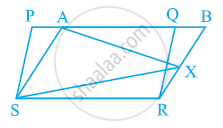
In the given figure, PQRS and ABRS are parallelograms and X is any point on side BR. Show that
(i) ar (PQRS) = ar (ABRS)
(ii) ar (AXS) = 1/2ar (PQRS)
In the following figure, ABCD is parallelogram and BC is produced to a point Q such that AD = CQ. If AQ intersect DC at P, show that
ar (BPC) = ar (DPQ).
[Hint: Join AC.]

ABCD is a parallelogram, G is the point on AB such that AG = 2 GB, E is a point of DC
such that CE = 2DE and F is the point of BC such that BF = 2FC. Prove that:
(1) ar ( ADEG) = ar (GBCD)
(2) ar (ΔEGB) = `1/6` ar (ABCD)
(3) ar (ΔEFC) = `1/2` ar (ΔEBF)
(4) ar (ΔEBG) = ar (ΔEFC)
(5)ΔFind what portion of the area of parallelogram is the area of EFG.
In which of the following figures, you find two polygons on the same base and between the same parallels?
Two parallelograms are on equal bases and between the same parallels. The ratio of their areas is ______.
PQRS is a rectangle inscribed in a quadrant of a circle of radius 13 cm. A is any point on PQ. If PS = 5 cm, then ar (PAS) = 30 cm2.
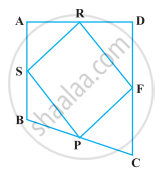
If the mid-points of the sides of a quadrilateral are joined in order, prove that the area of the parallelogram so formed will be half of the area of the given quadrilateral (Figure).
[Hint: Join BD and draw perpendicular from A on BD.]
The diagonals of a parallelogram ABCD intersect at a point O. Through O, a line is drawn to intersect AD at P and BC at Q. Show that PQ divides the parallelogram into two parts of equal area.
