Advertisements
Advertisements
Question
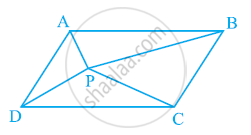
In the given figure, P is a point in the interior of a parallelogram ABCD. Show that
(i) ar (APB) + ar (PCD) = 1/2ar (ABCD)
(ii) ar (APD) + ar (PBC) = ar (APB) + ar (PCD)
[Hint: Through. P, draw a line parallel to AB]
Advertisements
Solution
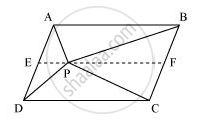
(i) Let us draw a line segment EF, passing through point P and parallel to line segment AB.
In parallelogram ABCD,
AB || EF (By construction) ... (1)
ABCD is a parallelogram.
∴ AD || BC (Opposite sides of a parallelogram)
⇒ AE || BF ... (2)
From equations (1) and (2), we obtain
AB || EF and AE || BF
Therefore, quadrilateral ABFE is a parallelogram.
It can be observed that ΔAPB and parallelogram ABFE are lying on the same base AB and between the same parallel lines AB and EF.
∴ Area (ΔAPB) = 1/2Area (ABFE) ... (3)
Similarly, for ΔPCD and parallelogram EFCD,
Area (ΔPCD) = 1/2Area (EFCD) ... (4)
Adding equations (3) and (4), we obtain
Area (ΔAPB) + Area (ΔPCD) = 1/2[Area (ABFE) + Area (EFCD)]
Area (ΔAPB) + Area (ΔPCD) = 1/2Area (ABCD) ........(5)
(ii)
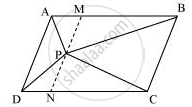
Let us draw a line segment MN, passing through point P and parallel to line segment AD.
In parallelogram ABCD,
MN || AD (By construction) ... (6)
ABCD is a parallelogram.
∴ AB || DC (Opposite sides of a parallelogram)
⇒ AM || DN ... (7)
From equations (6) and (7), we obtain
MN || AD and AM || DN
Therefore, quadrilateral AMND is a parallelogram.
It can be observed that ΔAPD and parallelogram AMND are lying on the same base AD and between the same parallel lines AD and MN.
∴ Area (ΔAPD) = 1/2Area (AMND) ... (8)
Similarly, for ΔPCB and parallelogram MNCB,
Area (ΔPCB) = 1/2Area (MNCB) ... (9)
Adding equations (8) and (9), we obtain
Area (ΔAPD) + Area (ΔPCB) = 1/2[Area (AMND) + Area (MNCB)]
Area (ΔAPD) + Area (ΔPCB) = 1/2Area (ABCD) ...........(10)
On comparing equations (5) and (10), we obtain
Area (ΔAPD) + Area (ΔPBC) = Area (ΔAPB) + Area (ΔPCD)
RELATED QUESTIONS
If E, F, G and H are respectively the mid-points of the sides of a parallelogram ABCD show that ar (EFGH) = 1/2ar (ABCD)
P and Q are any two points lying on the sides DC and AD respectively of a parallelogram ABCD. Show that ar (APB) = ar (BQC).
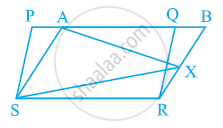
In the given figure, PQRS and ABRS are parallelograms and X is any point on side BR. Show that
(i) ar (PQRS) = ar (ABRS)
(ii) ar (AXS) = 1/2ar (PQRS)
A farmer was having a field in the form of a parallelogram PQRS. She took any point A on RS and joined it to points P and Q. In how many parts the field is divided? What are the shapes of these parts? The farmer wants to sow wheat and pulses in equal portions of the field separately. How should she do it?
Parallelogram ABCD and rectangle ABEF are on the same base AB and have equal areas. Show that the perimeter of the parallelogram is greater than that of the rectangle.
In the following figure, ABCD is parallelogram and BC is produced to a point Q such that AD = CQ. If AQ intersect DC at P, show that
ar (BPC) = ar (DPQ).
[Hint: Join AC.]

In the below fig. ABCD and AEFD are two parallelograms. Prove that
(1) PE = FQ
(2) ar (Δ APE) : ar (ΔPFA) = ar Δ(QFD) : ar (Δ PFD)
(3) ar (ΔPEA) = ar (ΔQFD)
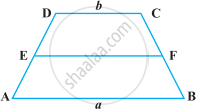
ABCD is a trapezium with parallel sides AB = a cm and DC = b cm (Figure). E and F are the mid-points of the non-parallel sides. The ratio of ar (ABFE) and ar (EFCD) is ______.
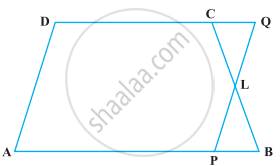
In trapezium ABCD, AB || DC and L is the mid-point of BC. Through L, a line PQ || AD has been drawn which meets AB in P and DC produced in Q (Figure). Prove that ar (ABCD) = ar (APQD)
The diagonals of a parallelogram ABCD intersect at a point O. Through O, a line is drawn to intersect AD at P and BC at Q. Show that PQ divides the parallelogram into two parts of equal area.
