Advertisements
Advertisements
Question
Parallelogram ABCD and rectangle ABEF are on the same base AB and have equal areas. Show that the perimeter of the parallelogram is greater than that of the rectangle.
Advertisements
Solution
As the parallelogram and the rectangle have the same base and equal area, therefore, these will also lie between the same parallels.
Consider the parallelogram ABCD and rectangle ABEF as follows.
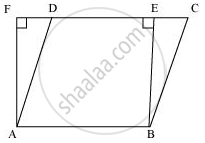
Here, it can be observed that parallelogram ABCD and rectangle ABEF are between the same parallels AB and CF.
We know that opposite sides of a parallelogram or a rectangle are of equal lengths. Therefore,
AB = EF (For rectangle)
AB = CD (For parallelogram)
∴ CD = EF
⇒ AB + CD = AB + EF ... (1)
Of all the line segments that can be drawn to a given line from a point not lying on it, the perpendicular line segment is the shortest.
∴ AF < AD
And similarly, BE < BC
∴ AF + BE < AD + BC ... (2)
From equations (1) and (2), we obtain
AB + EF + AF + BE < AD + BC + AB + CD
Perimeter of rectangle ABEF < Perimeter of parallelogram ABCD
RELATED QUESTIONS
In the given figure, ABCD is parallelogram, AE ⊥ DC and CF ⊥ AD. If AB = 16 cm, AE = 8 cm and CF = 10 cm, find AD.

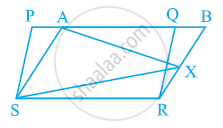
In the given figure, PQRS and ABRS are parallelograms and X is any point on side BR. Show that
(i) ar (PQRS) = ar (ABRS)
(ii) ar (AXS) = 1/2ar (PQRS)
In the following figure, ABCD is parallelogram and BC is produced to a point Q such that AD = CQ. If AQ intersect DC at P, show that
ar (BPC) = ar (DPQ).
[Hint: Join AC.]

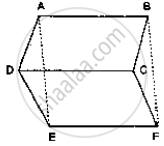
In the given below fig. ABCD, ABFE and CDEF are parallelograms. Prove that ar (ΔADE)
= ar (ΔBCF)
In which of the following figures, you find two polygons on the same base and between the same parallels?
Two parallelograms are on equal bases and between the same parallels. The ratio of their areas is ______.
In the following figure, PSDA is a parallelogram. Points Q and R are taken on PS such that PQ = QR = RS and PA || QB || RC. Prove that ar (PQE) = ar (CFD).

ABCD is a square. E and F are respectively the mid-points of BC and CD. If R is the mid-point of EF (Figure), prove that ar (AER) = ar (AFR)

In trapezium ABCD, AB || DC and L is the mid-point of BC. Through L, a line PQ || AD has been drawn which meets AB in P and DC produced in Q (Figure). Prove that ar (ABCD) = ar (APQD)

The diagonals of a parallelogram ABCD intersect at a point O. Through O, a line is drawn to intersect AD at P and BC at Q. Show that PQ divides the parallelogram into two parts of equal area.
