Advertisements
Advertisements
Question
In the following figure, PSDA is a parallelogram. Points Q and R are taken on PS such that PQ = QR = RS and PA || QB || RC. Prove that ar (PQE) = ar (CFD).

Advertisements
Solution
Given: In a parallelogram PSDA, points Q and R are on PS such that
PQ = QR = RS and PA || QB || RC.
To prove: ar (PQE) = ar (CFD)
Proof: In parallelogram PABQ,
And PA || QB ...[Given]
So, PABQ is a parallelogram.
PQ = AB ...(i)
Similarly, QBCR is also a parallelogram.
QR = BC ...(ii)
And RCDS is a parallelogram.
RS = CD ...(iii)
Now, PQ = QR = RS ...(iv)
From equations (i), (ii), (iii) and (iv),
PQ || AB ...[∴ In parallelogram PSDA, PS || AD]
In ΔPQE and ΔDCF,
∠QPE = ∠FDC ...[Since, PS || AD and PD is transversal, then alternate interior angles are equal]
PQ = CD ...[From equation (v)]
And ∠PQE = ∠FCD ...[∴ ∠PQE = ∠PRC corresponding angles and ∠PRC = ∠FCD alternate interior angles]
ΔPQE = ΔDCF ...[By ASA congruence rule]
∴ ar (ΔPQE) = ar (ΔCFD) ...[Since, congruent figures have equal area]
Hence proved.
APPEARS IN
RELATED QUESTIONS
In the given figure, ABCD is parallelogram, AE ⊥ DC and CF ⊥ AD. If AB = 16 cm, AE = 8 cm and CF = 10 cm, find AD.

If E, F, G and H are respectively the mid-points of the sides of a parallelogram ABCD show that ar (EFGH) = 1/2ar (ABCD)
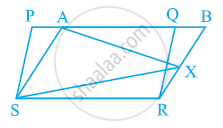
In the given figure, PQRS and ABRS are parallelograms and X is any point on side BR. Show that
(i) ar (PQRS) = ar (ABRS)
(ii) ar (AXS) = 1/2ar (PQRS)
In the following figure, ABCD is parallelogram and BC is produced to a point Q such that AD = CQ. If AQ intersect DC at P, show that
ar (BPC) = ar (DPQ).
[Hint: Join AC.]

ABCD is a parallelogram, G is the point on AB such that AG = 2 GB, E is a point of DC
such that CE = 2DE and F is the point of BC such that BF = 2FC. Prove that:
(1) ar ( ADEG) = ar (GBCD)
(2) ar (ΔEGB) = `1/6` ar (ABCD)
(3) ar (ΔEFC) = `1/2` ar (ΔEBF)
(4) ar (ΔEBG) = ar (ΔEFC)
(5)ΔFind what portion of the area of parallelogram is the area of EFG.
In the below fig. ABCD and AEFD are two parallelograms. Prove that
(1) PE = FQ
(2) ar (Δ APE) : ar (ΔPFA) = ar Δ(QFD) : ar (Δ PFD)
(3) ar (ΔPEA) = ar (ΔQFD)
Two parallelograms are on equal bases and between the same parallels. The ratio of their areas is ______.
PQRS is a rectangle inscribed in a quadrant of a circle of radius 13 cm. A is any point on PQ. If PS = 5 cm, then ar (PAS) = 30 cm2.
In trapezium ABCD, AB || DC and L is the mid-point of BC. Through L, a line PQ || AD has been drawn which meets AB in P and DC produced in Q (Figure). Prove that ar (ABCD) = ar (APQD)

ABCD is a trapezium in which AB || DC, DC = 30 cm and AB = 50 cm. If X and Y are, respectively the mid-points of AD and BC, prove that ar (DCYX) = `7/9` ar (XYBA)
