Advertisements
Advertisements
प्रश्न
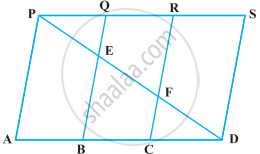
In the following figure, PSDA is a parallelogram. Points Q and R are taken on PS such that PQ = QR = RS and PA || QB || RC. Prove that ar (PQE) = ar (CFD).
Advertisements
उत्तर
Given: In a parallelogram PSDA, points Q and R are on PS such that
PQ = QR = RS and PA || QB || RC.
To prove: ar (PQE) = ar (CFD)
Proof: In parallelogram PABQ,
And PA || QB ...[Given]
So, PABQ is a parallelogram.
PQ = AB ...(i)
Similarly, QBCR is also a parallelogram.
QR = BC ...(ii)
And RCDS is a parallelogram.
RS = CD ...(iii)
Now, PQ = QR = RS ...(iv)
From equations (i), (ii), (iii) and (iv),
PQ || AB ...[∴ In parallelogram PSDA, PS || AD]
In ΔPQE and ΔDCF,
∠QPE = ∠FDC ...[Since, PS || AD and PD is transversal, then alternate interior angles are equal]
PQ = CD ...[From equation (v)]
And ∠PQE = ∠FCD ...[∴ ∠PQE = ∠PRC corresponding angles and ∠PRC = ∠FCD alternate interior angles]
ΔPQE = ΔDCF ...[By ASA congruence rule]
∴ ar (ΔPQE) = ar (ΔCFD) ...[Since, congruent figures have equal area]
Hence proved.
APPEARS IN
संबंधित प्रश्न
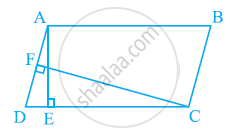
In the given figure, ABCD is parallelogram, AE ⊥ DC and CF ⊥ AD. If AB = 16 cm, AE = 8 cm and CF = 10 cm, find AD.
A farmer was having a field in the form of a parallelogram PQRS. She took any point A on RS and joined it to points P and Q. In how many parts the field is divided? What are the shapes of these parts? The farmer wants to sow wheat and pulses in equal portions of the field separately. How should she do it?
ABCD is a parallelogram, G is the point on AB such that AG = 2 GB, E is a point of DC
such that CE = 2DE and F is the point of BC such that BF = 2FC. Prove that:
(1) ar ( ADEG) = ar (GBCD)
(2) ar (ΔEGB) = `1/6` ar (ABCD)
(3) ar (ΔEFC) = `1/2` ar (ΔEBF)
(4) ar (ΔEBG) = ar (ΔEFC)
(5)ΔFind what portion of the area of parallelogram is the area of EFG.
In the below fig. ABCD and AEFD are two parallelograms. Prove that
(1) PE = FQ
(2) ar (Δ APE) : ar (ΔPFA) = ar Δ(QFD) : ar (Δ PFD)
(3) ar (ΔPEA) = ar (ΔQFD)
Two parallelograms are on equal bases and between the same parallels. The ratio of their areas is ______.
ABCD is a square. E and F are respectively the mid-points of BC and CD. If R is the mid-point of EF (Figure), prove that ar (AER) = ar (AFR)

ABCD is a parallelogram in which BC is produced to E such that CE = BC (Figure). AE intersects CD at F. If ar (DFB) = 3 cm2, find the area of the parallelogram ABCD.
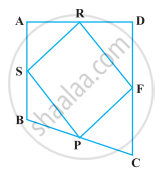
If the mid-points of the sides of a quadrilateral are joined in order, prove that the area of the parallelogram so formed will be half of the area of the given quadrilateral (Figure).
[Hint: Join BD and draw perpendicular from A on BD.]
The diagonals of a parallelogram ABCD intersect at a point O. Through O, a line is drawn to intersect AD at P and BC at Q. Show that PQ divides the parallelogram into two parts of equal area.
ABCD is a trapezium in which AB || DC, DC = 30 cm and AB = 50 cm. If X and Y are, respectively the mid-points of AD and BC, prove that ar (DCYX) = `7/9` ar (XYBA)
