Advertisements
Advertisements
Question
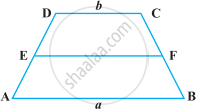
ABCD is a trapezium with parallel sides AB = a cm and DC = b cm (Figure). E and F are the mid-points of the non-parallel sides. The ratio of ar (ABFE) and ar (EFCD) is ______.
Options
a : b
(3a + b) : (a + 3b)
(a + 3b) : (3a + b)
(2a + b) : (3a + b)
Advertisements
Solution
ABCD is a trapezium with parallel sides AB = a cm and DC = b cm (Figure). E and F are the mid-points of the non-parallel sides. The ratio of ar (ABFE) and ar (EFCD) is (3a + b) : (a + 3b).
Explanation:
Given, AB = a cm, DC = b cm and AB || DC.
Also, E and F are mid-points of AD and BC, respectively.
So, distance between CD, EF and AB, EF will be same say h.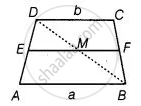
Join BD which intersect EF at M.
Now, in ΔABD, E is the mid-point of AD and EM || AB
So, M is the mid-point of BD
And EM = `1/2`AB [By mid-point theorem] ...(i)
Similarly in ΔCBD, MF = `1/2`CD ...(ii)
On adding equations (i) and (ii), we get
EM + MF = `1/2` AB + `1/2` CD
⇒ EF = `1/2`(AB + CD) = `1/2`(a + b)
Now, area of trapezium ABFE
= `1/2`(sum of parallel sides) × (distance between parallel sides)
= `1/2(a + 1/2(a + b)) xx h`
= `1/4(3a + b)h`
Now, area of trapezium EFCD
= `1/2[b + 1/2(a + b)] xx h`
= `1/4(3b + a)h`
∴ Required ratio = `"Area of ABFE"/"Area of EFCD"`
= `(1/4(3a + b)h)/(1/4(3b + a)h)`
= `((3a + b))/((a + 3b))` or (3a + b) : (a + 3b)
RELATED QUESTIONS
If E, F, G and H are respectively the mid-points of the sides of a parallelogram ABCD show that ar (EFGH) = 1/2ar (ABCD)
Parallelogram ABCD and rectangle ABEF are on the same base AB and have equal areas. Show that the perimeter of the parallelogram is greater than that of the rectangle.
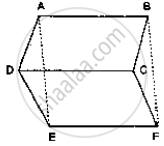
In the given below fig. ABCD, ABFE and CDEF are parallelograms. Prove that ar (ΔADE)
= ar (ΔBCF)
ABCD is a parallelogram, G is the point on AB such that AG = 2 GB, E is a point of DC
such that CE = 2DE and F is the point of BC such that BF = 2FC. Prove that:
(1) ar ( ADEG) = ar (GBCD)
(2) ar (ΔEGB) = `1/6` ar (ABCD)
(3) ar (ΔEFC) = `1/2` ar (ΔEBF)
(4) ar (ΔEBG) = ar (ΔEFC)
(5)ΔFind what portion of the area of parallelogram is the area of EFG.
In the below fig. ABCD and AEFD are two parallelograms. Prove that
(1) PE = FQ
(2) ar (Δ APE) : ar (ΔPFA) = ar Δ(QFD) : ar (Δ PFD)
(3) ar (ΔPEA) = ar (ΔQFD)
In which of the following figures, you find two polygons on the same base and between the same parallels?
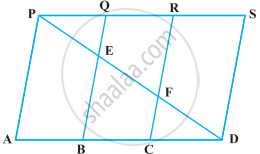
In the following figure, PSDA is a parallelogram. Points Q and R are taken on PS such that PQ = QR = RS and PA || QB || RC. Prove that ar (PQE) = ar (CFD).
ABCD is a square. E and F are respectively the mid-points of BC and CD. If R is the mid-point of EF (Figure), prove that ar (AER) = ar (AFR)

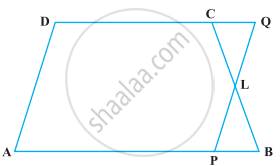
In trapezium ABCD, AB || DC and L is the mid-point of BC. Through L, a line PQ || AD has been drawn which meets AB in P and DC produced in Q (Figure). Prove that ar (ABCD) = ar (APQD)
If the mid-points of the sides of a quadrilateral are joined in order, prove that the area of the parallelogram so formed will be half of the area of the given quadrilateral (Figure).
[Hint: Join BD and draw perpendicular from A on BD.]