Advertisements
Advertisements
प्रश्न
The medians BE and CF of a triangle ABC intersect at G. Prove that the area of ∆GBC = area of the quadrilateral AFGE.
Advertisements
उत्तर
Given: The medians BE and CF of a triangle ABC intersect at G
To prove: ar (ΔGBC) = ar (AFCE)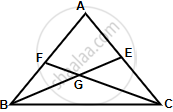
Proof: As median CF divides a triangle into triangle of equal area. So, ar (ΔBCF) = ar (ΔACF)
ar (ΔGBF) + ar (ΔGBC) = ar (AFGE) + ar (ΔGCE) ...(I)
Now, median BE divides a triangle into two triangle of equal area.
So, ar (ΔGBF) + ar (AFGE) = ar (ΔGCE) + ar (ΔGBC) ...(II)
Now, subtracting (II) from (I), we get
ar (ΔGBC) – ar (AFGE) = ar (ΔAFGE) – ar (ΔGBC)
ar (ΔGBC) + ar (ΔGBC) = ar (ΔAFGE) + ar (ΔAFGE)
2ar (ΔGBC) = 2ar (AFGE)
Hence, ar (ΔGBC) = ar (AFGE).
APPEARS IN
संबंधित प्रश्न
In the given figure, ABC and ABD are two triangles on the same base AB. If line-segment CD is bisected by AB at O, show that ar (ABC) = ar (ABD).

D, E and F are respectively the mid-points of the sides BC, CA and AB of a ΔABC. Show that
(i) BDEF is a parallelogram.
(ii) ar (DEF) = 1/4ar (ABC)
(iii) ar (BDEF) = 1/2ar (ABC)
In the given figure, ABCDE is a pentagon. A line through B parallel to AC meets DC produced at F. Show that
(i) ar (ACB) = ar (ACF)
(ii) ar (AEDF) = ar (ABCDE)

P and Q are respectively the mid-points of sides AB and BC of a triangle ABC and R is the mid-point of AP, show that
(i) ar(PRQ) = 1/2 ar(ARC)
(ii) ar(RQC) = 3/8 ar(ABC)
(iii) ar(PBQ) = ar(ARC)
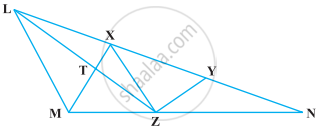
X and Y are points on the side LN of the triangle LMN such that LX = XY = YN. Through X, a line is drawn parallel to LM to meet MN at Z (See figure). Prove that ar (LZY) = ar (MZYX)
The area of the parallelogram ABCD is 90 cm2 (see figure). Find ar (ΔBEF)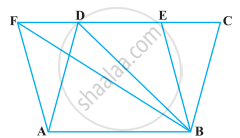
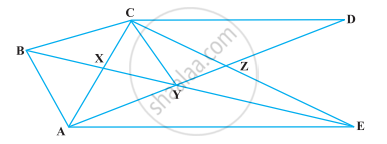
In the following figure, CD || AE and CY || BA. Prove that ar (CBX) = ar (AXY).
In ∆ABC, if L and M are the points on AB and AC, respectively such that LM || BC. Prove that ar (LOB) = ar (MOC)
In the following figure, ABCDE is any pentagon. BP drawn parallel to AC meets DC produced at P and EQ drawn parallel to AD meets CD produced at Q. Prove that ar (ABCDE) = ar (APQ)
In the following figure, X and Y are the mid-points of AC and AB respectively, QP || BC and CYQ and BXP are straight lines. Prove that ar (ABP) = ar (ACQ).

