Advertisements
Advertisements
Question
The medians BE and CF of a triangle ABC intersect at G. Prove that the area of ∆GBC = area of the quadrilateral AFGE.
Advertisements
Solution
Given: The medians BE and CF of a triangle ABC intersect at G
To prove: ar (ΔGBC) = ar (AFCE)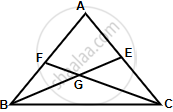
Proof: As median CF divides a triangle into triangle of equal area. So, ar (ΔBCF) = ar (ΔACF)
ar (ΔGBF) + ar (ΔGBC) = ar (AFGE) + ar (ΔGCE) ...(I)
Now, median BE divides a triangle into two triangle of equal area.
So, ar (ΔGBF) + ar (AFGE) = ar (ΔGCE) + ar (ΔGBC) ...(II)
Now, subtracting (II) from (I), we get
ar (ΔGBC) – ar (AFGE) = ar (ΔAFGE) – ar (ΔGBC)
ar (ΔGBC) + ar (ΔGBC) = ar (ΔAFGE) + ar (ΔAFGE)
2ar (ΔGBC) = 2ar (AFGE)
Hence, ar (ΔGBC) = ar (AFGE).
APPEARS IN
RELATED QUESTIONS
In a triangle ABC, E is the mid-point of median AD. Show that ar (BED) = 1/4ar (ABC).
In the given figure, ABC and ABD are two triangles on the same base AB. If line-segment CD is bisected by AB at O, show that ar (ABC) = ar (ABD).

D, E and F are respectively the mid-points of the sides BC, CA and AB of a ΔABC. Show that
(i) BDEF is a parallelogram.
(ii) ar (DEF) = 1/4ar (ABC)
(iii) ar (BDEF) = 1/2ar (ABC)
In the given figure, diagonals AC and BD of quadrilateral ABCD intersect at O such that OB = OD. If AB = CD, then show that:
(i) ar (DOC) = ar (AOB)
(ii) ar (DCB) = ar (ACB)
(iii) DA || CB or ABCD is a parallelogram.
[Hint: From D and B, draw perpendiculars to AC.]

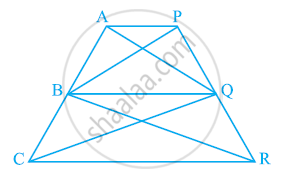
In the given figure, AP || BQ || CR. Prove that ar (AQC) = ar (PBR).
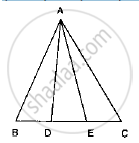
In the below fig. D and E are two points on BC such that BD = DE = EC. Show that ar
(ΔABD) = ar (ΔADE) = ar (ΔAEC).
In a ΔABC, if L and M are points on AB and AC respectively such that LM || BC. Prove
that:
(1) ar (ΔLCM ) = ar (ΔLBM )
(2) ar (ΔLBC) = ar (ΔMBC)
(3) ar (ΔABM) ar (ΔACL)
(4) ar (ΔLOB) ar (ΔMOC)
If a triangle and a parallelogram are on the same base and between same parallels, then the ratio of the area of the triangle to the area of parallelogram is ______.
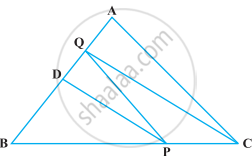
In ∆ABC, D is the mid-point of AB and P is any point on BC. If CQ || PD meets AB in Q (Figure), then prove that ar (BPQ) = `1/2` ar (∆ABC).
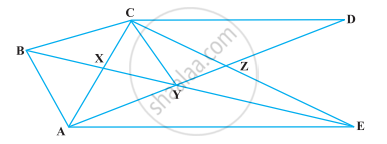
In the following figure, CD || AE and CY || BA. Prove that ar (CBX) = ar (AXY).