Advertisements
Advertisements
Question
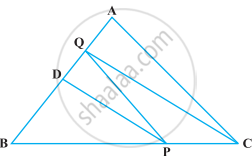
In the following figure, X and Y are the mid-points of AC and AB respectively, QP || BC and CYQ and BXP are straight lines. Prove that ar (ABP) = ar (ACQ).

Advertisements
Solution
Given: X and Y are the mid-points of AC and AB respectively. Also, QP || BC and CYQ, BXP are straight lines.
To prove: ar (ΔABP) = ar (ΔACQ)
Proof: Since, X and Y are the mid-points of AC and AB respectively.
So, XY || BC
We know that, triangles on the same base and between the same parallels are equal in area.
Here, ΔBYC and ΔBXC lie on same base BC and between the same parallels BC and XY.
So, ar (ΔBYC) = ar (ΔBXC)
On subtracting ar (ΔBOC) from both sides, we get
ar (ΔBYC) – ar (ΔBOC) = ar (ΔBXC) – ar (ΔBOC)
=» ar (ΔBOY) = ar (ΔCOX)
On adding ar (ΔXOY) both sides, we get
ar (ΔSOY) + ar (ΔXOY) = ar (ΔCOX) + ar (ΔXOY)
⇒ ar (ΔBYX) = ar (ΔCXY) ...(i)
Hence, we observe that quadrilaterals XYAP and YXAQ are on the same base XY and between the same parallels XY and PQ.
ar (XYAP) = ar (YXAQ) ...(ii)
On adding equations (i) and (ii), we get
ar (ΔBYX) + ar (XYAP) = ar (ΔCXY) + ar (YXAQ)
⇒ ar (ΔABP) = ar (ΔACQ)
Hence proved.
APPEARS IN
RELATED QUESTIONS
D and E are points on sides AB and AC respectively of ΔABC such that
ar (DBC) = ar (EBC). Prove that DE || BC.
In the given figure, ABCDE is a pentagon. A line through B parallel to AC meets DC produced at F. Show that
(i) ar (ACB) = ar (ACF)
(ii) ar (AEDF) = ar (ABCDE)

ABCD is a trapezium with AB || DC. A line parallel to AC intersects AB at X and BC at Y. Prove that ar (ADX) = ar (ACY).
[Hint: Join CX.]
Diagonals AC and BD of a quadrilateral ABCD intersect at O in such a way that ar (AOD) = ar (BOC). Prove that ABCD is a trapezium.
In the given figure, ar (DRC) = ar (DPC) and ar (BDP) = ar (ARC). Show that both the quadrilaterals ABCD and DCPR are trapeziums.

In the following figure, ABC is a right triangle right angled at A. BCED, ACFG and ABMN are squares on the sides BC, CA and AB respectively. Line segment AX ⊥ DE meets BC at Y. Show that:-
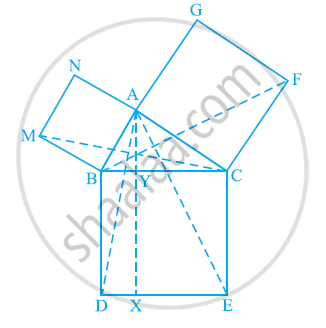
(i) ΔMBC ≅ ΔABD
(ii) ar (BYXD) = 2 ar(MBC)
(iii) ar (BYXD) = ar(ABMN)
(iv) ΔFCB ≅ ΔACE
(v) ar(CYXE) = 2 ar(FCB)
(vi) ar (CYXE) = ar(ACFG)
(vii) ar (BCED) = ar(ABMN) + ar(ACFG)
Note : Result (vii) is the famous Theorem of Pythagoras. You shall learn a simpler proof of this theorem in Class X.
PQRS is a parallelogram whose area is 180 cm2 and A is any point on the diagonal QS. The area of ∆ASR = 90 cm2.
ABC and BDE are two equilateral triangles such that D is the mid-point of BC. Then ar (BDE) = `1/4` ar (ABC).
The area of the parallelogram ABCD is 90 cm2 (see figure). Find
- ar (ΔABEF)
- ar (ΔABD)
- ar (ΔBEF)
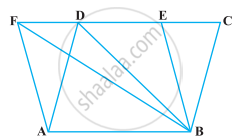
In ∆ABC, D is the mid-point of AB and P is any point on BC. If CQ || PD meets AB in Q (Figure), then prove that ar (BPQ) = `1/2` ar (∆ABC).