Advertisements
Advertisements
प्रश्न
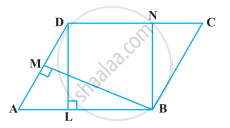
In the following figure, the area of parallelogram ABCD is ______.
विकल्प
AB × BM
BC × BN
DC × DL
AD × DL
Advertisements
उत्तर
In the following figure, the area of parallelogram ABCD is DC × DL.
Explanation:
We know that, area of parallelogram is the product of its any side and the corresponding altitude (or height).
Here, when AB is base, then height is DL.
Area of parallelogram = AB × DL and when AD is base, then height is BM.
Area of parallelogram = AD × BM When DC is base, then height is DL.
Area of parallelogram = DC × DL and when BC is base, then height is not given.
संबंधित प्रश्न
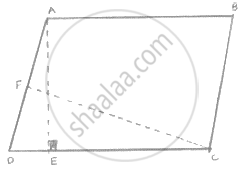
In fig below, ABCD is a parallelogram, AE ⊥ DC and CF ⊥ AD. If AB = 16 cm, AE = 8
cm and CF = 10 cm, find AD.
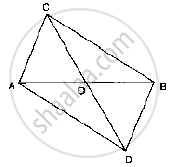
In the below Fig, ABC and ABD are two triangles on the base AB. If line segment CD is
bisected by AB at O, show that ar (Δ ABC) = ar (Δ ABD)
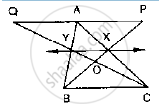
In the below fig. X and Y are the mid-points of AC and AB respectively, QP || BC and
CYQ and BXP are straight lines. Prove that ar (Δ ABP) = ar (ΔACQ).
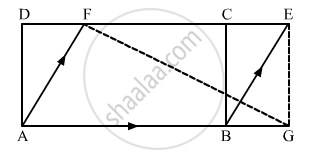
In the given figure, ABCD is a rectangle with sides AB = 10 cm and AD = 5 cm. Find the area of ΔEFG.
ABC is a triangle in which D is the mid-point of BC. E and F are mid-points of DC and AErespectively. IF area of ΔABC is 16 cm2, find the area of ΔDEF.
Two parallelograms are on the same base and between the same parallels. The ratio of their areas is
In a ΔABC, D, E, F are the mid-points of sides BC, CA and AB respectively. If ar (ΔABC) = 16cm2, then ar (trapezium FBCE) =
Find the area of a rectangle whose length = 15 cm breadth = 6.4 cm
Is the area of the blue shape more than the area of the yellow shape? Why?

The region given in the following figure is measured by taking  as a unit. What is the area of the region?