Advertisements
Advertisements
प्रश्न
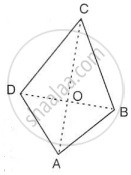
ABCD is a quadrilateral whose diagonals intersect each other at point O. The diagonal AC bisects diagonal BD. Then area of quadrilateral ABCD is ______.
विकल्प
2 × area of ΔABD
2 × area of ΔBCD
4 × area of ΔAOB
2 × area of ΔABC
MCQ
रिक्त स्थान भरें
Advertisements
उत्तर
ABCD is a quadrilateral whose diagonals intersect each other at point O. The diagonal AC bisects diagonal BD. Then area of quadrilateral ABCD is 2 × area of ΔABD.
Explanation:
- The diagonal AC divides the quadrilateral ABCD into two triangles: ΔABD and ΔCBD.
- Since diagonal AC bisects diagonal BD at point O, point O is the mid-point of BD.
- Therefore, segment DO = OB, which means AO acts as a median for both ΔABD (dividing it into ΔAOD and ΔAOB of equal area) and ΔCBD (dividing it into ΔCOD and ΔCOB of equal area).
- Because the area of ΔABD is equal to the area of ΔCBD (both sharing base BD and equal heights DO and OB from vertex A and C respectively, or simply being split symmetrically by the bisecting diagonal), the total area of the quadrilateral is the sum of these two equal triangle areas:
area of quadrilateral ABCD = area of ΔABD + area of ΔCBD = 2 × area of ΔABD
shaalaa.com
क्या इस प्रश्न या उत्तर में कोई त्रुटि है?
