Advertisements
Advertisements
प्रश्न
PQRS is a trapezium having PS and QR as parallel sides. A is any point on PQ and B is a point on SR such that AB || QR. If area of ΔPBQ is 17cm2, find the area of ΔASR.
Advertisements
उत्तर
Given: Here from the given figure we get
(1) PQRS is a trapezium having PS||QR
(2) A is any point on PQ
(3) B is any point on SR
(4) AB||QR
(5) Area of ΔBPQ = 17 cm2
To find : Area of ΔASR
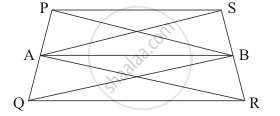
Calculation: We know that ‘If a triangle and a parallelogram are on the same base and the same parallels, the area of the triangle is equal to half the area of the parallelogram’
Here we can see that:
Area (ΔAPB) = Area (ΔABS) …… (1)
And, Area (ΔAQR) = Area (ΔABR) …… (2)
Therefore,
Area (ΔASR) = Area (ΔABS) + Area (ΔABR)
From equation (1) and (2), we have,
Area (ΔASR) = Area (ΔAPB) + Area (ΔAQR)
⇒ Area (ΔASR) = Area (ΔBPQ) = 17 cm2
Hence, the area of the triangle ΔASR is 17 cm2.
APPEARS IN
संबंधित प्रश्न
Two parallelograms are on the same base and between the same parallels. The ratio of their areas is
ABCD is a parallelogram. P is any point on CD. If ar (ΔDPA) = 15 cm2 and ar (ΔAPC) = 20 cm2, then ar (ΔAPB) =
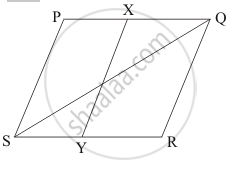
In the given figure, PQRS is a parallelogram. If X and Y are mid-points of PQ and SRrespectively and diagonal Q is joined. The ratio ar (||gm XQRY) : ar (ΔQSR) =
ABCD is a trapezium in which AB || DC. If ar (ΔABD) = 24 cm2 and AB = 8 cm, then height of ΔABC is
The medians of a triangle ABC intersect each other at point G. If one of its medians is AD,
prove that:
(i) Area ( ΔABD ) = 3 x Area ( ΔBGD )
(ii) Area ( ΔACD ) = 3 x Area ( ΔCGD )
(iii) Area ( ΔBGC ) = `1/3` x Area ( ΔABC ).
Length of a rectangle is 30 m and its breadth is 20 m. Find the increase in its area if its length is increased by 10 m and its breadth is doubled.
Who had the bigger piece? How much bigger?
Nasreena is a farmer who wants to divide her land equally among her three children — Chumki, Jhumri, and Imran. She wants to divide the land so that each piece of land has one tree. Her land looks like this.

- Can you divide the land equally? Show how you will divide it. Remember each person has to get a tree. Colour each person’s piece of land differently.
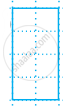
Find the area of the following figure by counting squares:
What is the area of a closed shape?
