Advertisements
Advertisements
प्रश्न
ABCD is a parallelogram. P is the mid-point of AB. BD and CP intersect at Q such that CQ: QP = 3.1. If ar (ΔPBQ) = 10cm2, find the area of parallelogram ABCD.
Advertisements
उत्तर
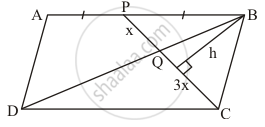
Proof:
Let, CQ = 3x & PQ = x
ar (ΔPBQ) = 10cm2 ...(1)
We know that, Area of Δ = ½ × Base × Height
ar (∆PBQ) = ½ × PQ × BQ
10 = ½ × x × h
[Let BQ = h ]
10 × 2 = xh
xh = 20 ...(2)
ar (∆BQC) = ½ × QC × BQ
ar (∆BQC) = ½ × 3(x × h)
ar (∆BQC) = ½ × 3 × 20
[From eq 2]
ar (∆BQC) = 3 × 10
ar (∆BQC) = 30 cm² ...(3)
Now,
ar (∆PCB) = ar (∆PBQ) + ar (∆BQC)
ar (∆PCB) = 10 + 30
[From eq 1 & 3]
ar (∆PCB) = 40 cm²
½ × PB × BC = 40 cm²
PB × BC = (40 × 2) cm²
PB × BC = 80 cm² ...(4)
Now, area of parallelogram = Base × Height
ar (|| gm ABCD) = AB × BC
ar (|| gm ABCD) = 2 PB × BC
[AB = 2 BP , P is the mid point of AB]
Area (ABCD) = 2 × 80
[From eq 4]
ar (ABCD) = 160 cm²
Hence, the area of parallelogram ABCD is 160 cm².
APPEARS IN
संबंधित प्रश्न
A point D is taken on the side BC of a ΔABC such that BD = 2DC. Prove that ar(Δ ABD) =
2ar (ΔADC).
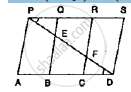
In below fig., PSDA is a parallelogram in which PQ = QR = RS and AP || BQ || CR. Prove
that ar (Δ PQE) = ar (ΔCFD).
The area of the figure formed by joining the mid-points of the adjacent sides of a rhombus with diagonals 16 cm and 12 cm is
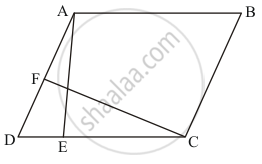
In the given figure, ABCD is a parallelogram. If AB = 12 cm, AE = 7.5 cm, CF = 15 cm, then AD =
A floor is 40 m long and 15 m broad. It is covered with tiles, each measuring 60 cm by 50 cm. Find the number of tiles required to cover the floor.
Find the area of a rectangle whose length = 24 cm breadth =180 mm
Each side of a square is 7 m. If its each side be increased by 3 m, what will be the increase in its area.
Parth and Gini bought aam papad (dried mango slice) from a shop. Their pieces looked like these. Both could not make out whose piece was bigger.
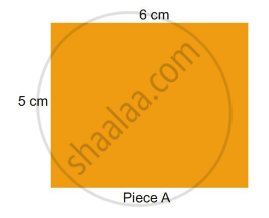

- Suggest some ways to find out whose piece is bigger. Discuss
This stamp has an area of 4 square cm. Guess how many such stamps will cover this big rectangle.
Is the area of your belt the same as the area of the postcard? Why or why not?
