Advertisements
Advertisements
Question
ABCD is a parallelogram. P is the mid-point of AB. BD and CP intersect at Q such that CQ: QP = 3.1. If ar (ΔPBQ) = 10cm2, find the area of parallelogram ABCD.
Advertisements
Solution
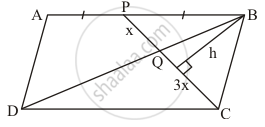
Proof:
Let, CQ = 3x & PQ = x
ar (ΔPBQ) = 10cm2 ...(1)
We know that, Area of Δ = ½ × Base × Height
ar (∆PBQ) = ½ × PQ × BQ
10 = ½ × x × h
[Let BQ = h ]
10 × 2 = xh
xh = 20 ...(2)
ar (∆BQC) = ½ × QC × BQ
ar (∆BQC) = ½ × 3(x × h)
ar (∆BQC) = ½ × 3 × 20
[From eq 2]
ar (∆BQC) = 3 × 10
ar (∆BQC) = 30 cm² ...(3)
Now,
ar (∆PCB) = ar (∆PBQ) + ar (∆BQC)
ar (∆PCB) = 10 + 30
[From eq 1 & 3]
ar (∆PCB) = 40 cm²
½ × PB × BC = 40 cm²
PB × BC = (40 × 2) cm²
PB × BC = 80 cm² ...(4)
Now, area of parallelogram = Base × Height
ar (|| gm ABCD) = AB × BC
ar (|| gm ABCD) = 2 PB × BC
[AB = 2 BP , P is the mid point of AB]
Area (ABCD) = 2 × 80
[From eq 4]
ar (ABCD) = 160 cm²
Hence, the area of parallelogram ABCD is 160 cm².
APPEARS IN
RELATED QUESTIONS
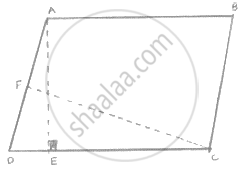
In fig below, ABCD is a parallelogram, AE ⊥ DC and CF ⊥ AD. If AB = 16 cm, AE = 8
cm and CF = 10 cm, find AD.
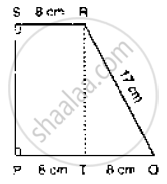
Compute the area of trapezium PQRS is Fig. below.
ABC is a triangle in which D is the mid-point of BC. E and F are mid-points of DC and AErespectively. IF area of ΔABC is 16 cm2, find the area of ΔDEF.
A triangle and a parallelogram are on the same base and between the same parallels. The ratio of the areas of triangle and parallelogram is
The figure obtained by joining the mid-points of the adjacent sides of a rectangle of sides 8 cm and 6 cm is ______.
The perimeter of a triangle ABC is 37 cm and the ratio between the lengths of its altitudes be 6: 5: 4. Find the lengths of its sides.
Let the sides be x cm, y cm, and (37 - x - y) cm. Also, let the lengths of altitudes be 6a cm, 5a cm, and 4a cm.
Karunya bought three fields.

Find the area of all three fields.
- Field (A) ____________ square metre.
- Field (B) ____________ square metre.
- Field (C) ____________ square metre.
Find all the possible dimensions (in natural numbers) of a rectangle with a perimeter 36 cm and find their areas.
Find the area of the following figure by counting squares:
What is the area of a closed shape?
